Search this Blog

Friday, April 25, 2025

Returning for A Guided Tour of "Stinking Southampton"!

Please excuse my tongue-in-cheek title, for this is reference made by Jane Austen, who associated Southampton with the smells of its "stinking" fish market situated close to Jane Austen's home. In her early work, Love and Freindship, Jane writes, "Beware of the unmeaning Luxuries of Bath and of the stinking fish of Southampton." (Letter the Fourth)

The site of Southampton's fish market at St Michael's Square down the road from Jane Austen's home. 

You may remember my tour of Jane Austen's Southampton from a few years ago. I was excited to return to Southampton again this year to participate in some of the Jane Austen 250 events that are taking place in the city where Jane Austen resided briefly with her brother Frank's family. 

My first port of call (please excuse the pun!) was the Sea City Museum, which is more famously known for its wonderful Titanic exhibit, which I recommend seeing if you are interested in the history of the Titanic. However, this year the museum is also hosting a small exhibition called  "A Very Respectable Company - Jane Austen and Her Southampton Circle", which discusses Jane Austen's association with the city. In the exhibition, you can learn about some of the people who Jane Austen associated with during her stay in Southampton.  

Jane visited Southampton to stay with her cousin, Elizabeth Harrison, in 1793, whose husband, John Butler Harrison, was mayor of Southampton. 

Elizabeth Mathilda Harrison in the 1830s with a lock of her hair. 

John Butler Harrison

During this visit, Jane celebrated her 18th birthday here and danced at the Dolphin Hotel on the occasion. You can see my photos from inside the Dolphin Hotel from my previous tour; sadly, it is no longer possible to visit the ballroom, as the building has been converted into student flats. 

The Dolphin Hotel with its Georgian bay windows. 


During her stay in Southampton, Mrs Harrison gave birth to her daughter, Elizabeth Matilda, and made Jane her godmother. 

Jane returned to Southampton from Bath in 1806 following the death of her father, as her naval officer brother, Frank, rescued Jane, her mother and sister Cassandra and their friend Marth Lloyd from genteel poverty. Frank was looking for a place to live, and Southampton was close to Portsmouth where Frank was stationed at the time; Frank found a home here and invited the ladies to stay with his growing family. Jane came to Southampton" with happy feelings of escape" and stayed until 1809 when Frank started having financial difficulties and could no longer support them. 

There is a household book on display at the museum, which belonged to the Austen family and may have been used here alongside Martha Lloyd's household book. The book was started by Jane Austen's great-great-grandmother, Elizabeth Weller, in around 1700 and was passed down the female line in the family. This page shows recipes such as Indian curry and black pudding. 
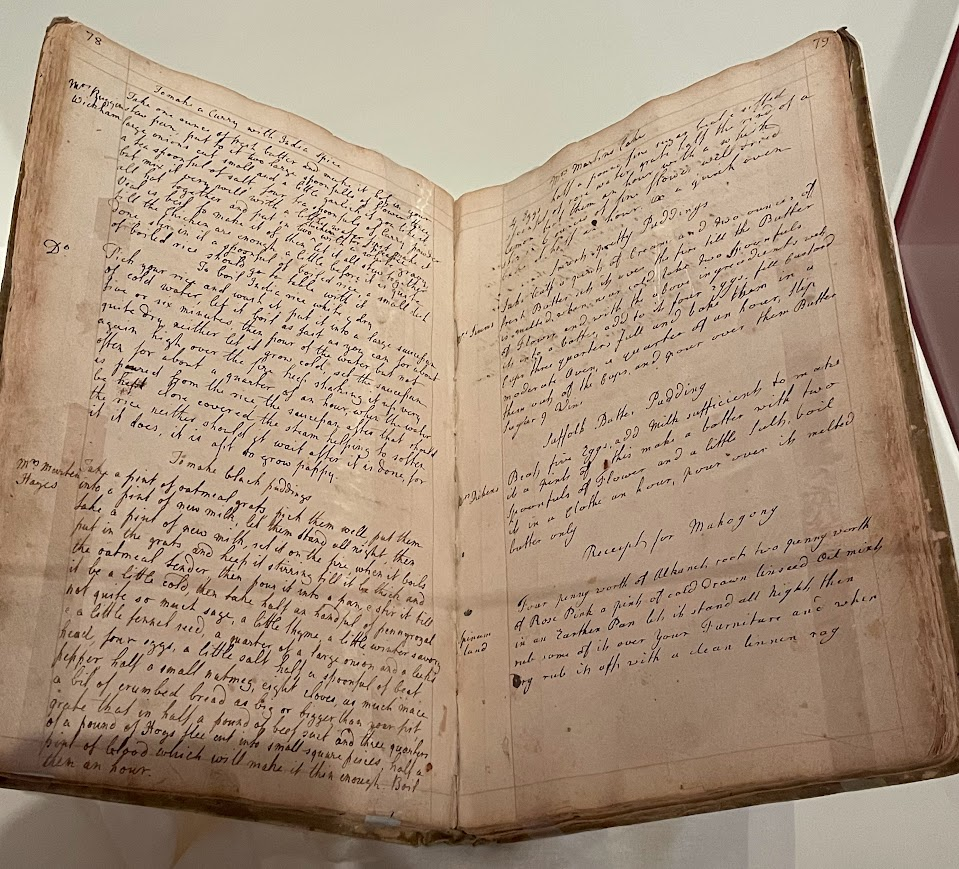
The Austens' household book. 

Although the Austens lead a fairly quiet life here, enjoying seaside walks and gardening, they had  a busy social life, too. The exhibition discusses the various families that Jane Austen visited during her stay here who were mostly connected through the army, navy and East India Company, such as the FitzHugh and Lance families. 

There is also a fascinating exhibition at Sea City that reveals the city's darker history of slavery. It is no secret that the wealth of Southampton was largely a result of its transatlantic slave trade. It is good to bear in mind that, whilst the city's wealthy population enjoyed the leisure activities that the city had on offer, these joys were made possible by the hard, forced labour of those much less fortunate. 

The medieval walls of Southampton.

From the exhibition I learnt that, in 1800, Southampton was an elegant town with 8000 inhabitants. It was quite a small town, contained within its medieval walls, and had a narrow network of medieval streets. There was also a pretty seaside boulevard where Jane Austen enjoyed walking, but sadly this no longer exists. The town was heavily bombed in the Second World War and no longer looks the same, but some of these medieval and Georgian buildings still exist. 
After the museum visit, I participated in a guided walking tour around Jane Austen's Southampton, as I wanted to learn more about the history of this area. 

The medieval God's House Tower 

The tour started from God's House Tower by the seaside that was used to protect the city in the medieval times and was used a prison in Jane Austen's times. The worst criminals such as murderers and debtors were kept in the tower of this building.  


On the other side of the building next door, there is a plaque explaining Jane Austen's connection to this area. It was wonderful to see so many plaques for Jane Austen in various parts of the city, which I will share in this post. This plaque talks about how Jane used to promenade here by the seaside, and her brother, Frank, ice-skated here in the winter. 

The site of Sugar House. Jane went to school nearby here. 

Walking up the road from here, we come to the site of the Sugar House where sugar was refined. Jane Austen went to boarding school somewhere in the vicinity with her sister Cassandra and cousin Jane Cooper in 1873. Typhus broke out in the Sugar House, and this affected Jane, Cassandra and Jane, too, who all became very unwell and Jane herself was severely affected by the disease. Thankfully, Jane survived the illness, but her cousin's mother Mrs Cooper caught the fever and passed away. It is believed that Jane's early illness might have shortened her life later on. 

We walked up the road towards Jane Austen's home, following the medieval city wall. 

The Austens stayed in a house right behind the city wall facing the sea, where the black-and-white beamed building now is. 

Jane stayed with her brother, Frank's family at No 2 Castle Square. There is new plaque on the wall of Juniper Inn, the site of the Austens' former home, which was sadly demolished in 1903.


The site of No 2 Castle Square.

Castle Square. The second on the left building was Lansdowne House. 

No 2 Castle Square was a tall, three-storey building, and the Austens rented the building from their neighbour, John Petty, 2nd Marquis of Lansdowne. The house was in what had been the centre of the medieval town and probably used to belong to a medieval merchant and later given a Palladian makeover. 

Lansdowne House. 

Across the square, there was a gothic style castle built by The Marquis around the ruins of the medieval castle. This was pulled down after a decade, but the Georgian style Lansdowne House where Lady Lansdowne lived during her widowhood still stands.   


From the photo above, you can see a tall building behind the city wall and Juniper Berry on the right. The tall building is where the Marquis' gothic castle stood when Jane stayed here.


During Jane Austen's times, Southampton was a spa resort where people came to bathe and take the waters, much like Bath, Lyme Regis and other such places. The Long Rooms and Hot Baths were a fashionable place for social gatherings and, according to this plaque, the Austens danced in the Long Rooms in January 1807. Like many other buildings, this no longer exists, but the picture in the plaque gives us an idea of what they will have looked like. 

Holyrood Church 

We then walked past Holyrood Church where Jane's neighbour, Hugh Hill, preached. This was not the church where the Austens worshipped, as they preferred All Saints Church, but there is a plaque for a famous composer of the time, Charles Dibdin, who was babtised here. His music was very popular, and Jane owned copies of his work; in fact, she copied his song, Soldier's Lament, for the pianoforte, amending the title to Sailor's Lament! 


On the way back from the High Street, we stopped to see the site of the Theatre Royal where Jane watched two plays in 1798: "Of Age Tomorrow" and "The Way to Keep Him". Jane enjoyed theatre and was excited to see the building but was unimpressed. She was also disappointed that she didn't get to see Sarah Siddons, a resident of Southampton, whom she admired and who performed at the theatre several times. 

Ansbach House (left) next to Westgate.

We also stopped in front of Ansbach House next to Westgate, where the author, Lady Elizabeth Craven, lived during Jane's stay here. She was a flamboyant personality who had affairs and travelled extensively around Europe. Her life was not without scandal, and she would certainly deserve an interesting post of her own!


We ended the tour at Westgate, which had a plaque explaining that Jane would embark a boat from here to visit Hythe with family members. There are so many memorial plaques and references dotted around the town that it is quite overwhelming!

I thoroughly enjoyed my guided tour of Jane Austen's Southampton and learnt a lot from the knowledgeable guides here. If you would like to participate in a similar tour, you can book it through here

To see my previous tour of Southampton, click here: https://austenised.blogspot.com/2019/10/a-tour-of-southampton-with-happy.html

References and further reading: 

Butler, C. (2017). Jane Austen and Southampton Spa. The Diaper Heritage Association. 


Monday, March 24, 2025

Reading (town) at the time of Jane Austen

Did you know that Reading had a connection to Jane Austen? I had to change the title in case readers mistook "Reading" for the verb rather than the name of the town! In case you didn't know, the town of Reading is pronounced as "re-ding" rather than "reading". 


You may have read my blog about Abbey School from my first visit to Reading where I wrote about Jane's school experience here. From 1785-1786, for a short duration of 18 months, Jane Austen went to school in Reading, and her brief stint at school took place in the Abbey Gateway. 

The Abbey Gateway 

The Abbey Gateway is the former entrance into Reading Abbey, which was one of the largest, most significant monasteries in Europe in medieval times but now stands in ruins. 

Georgian buildings near the Abbey ruins. 


The Abbey ruins. 

The gateway was actually built in the medieval times to divide the monk's living quarters from the more public areas of the abbey, but the current building dates back to Tudor times. Jane is the most famous alumnus from this school, and I believe that Jane's experience of living so close to a gothic abbey sparked her imagination in her future writing, Northanger Abbey in particular. 


Gothic detail from the Gateway.

visited the Abbey Gateway for a children's event with my children back in 2018, and it was so interesting to see the interiors of the Gateway where Jane's classroom was located. This year, marking Jane Austen 250, you can visit the classroom on certain days and see for yourself where Jane Austen went to school. 

Forbury Gardens with the Victorian Schoolhouse in the middle next to the Abbey ruins. Reading Gaol was behind the schoolhouse. 

The gateway is located opposite Forbury Gardens, which had been used as a "forbury" (i.e. borough in front) or an open land between the abbey and the town, and this open land was used for fairs for centuries, including when Jane Austen was here. The gardens now offer a gorgeous respite from the urban areas and a lovely place to stroll around. 

Between the abbey and the gardens, there is a Victorian building, Reading Gaol. This is where Oscar Wilde was famously imprisoned 1895-1897 for homosexual offences and where he wrote the poem, "Reading Gaol". 

St Laurence's Church. 

Jane would also have been familiar with St Laurence's Church, which was situated on the same road, past Forbury Gardens. This church was also built in the Norman times but has been rebuilt in the 15th and 19th Centuries. St Laurence's Church was one of the original three churches serving the Reading borough from the medieval times, but had a larger significance due to its close location to the abbey, which stimulated trade in the area. 

Reading marketplace. 

Reading marketplace in front of the church was established by the abbey monks and was used for markets for hundreds of years and, as you can see, is still used today. 

The Simeon monument. 

Jane Austen would have been familiar with this marketplace, but she wouldn't have seen the Simeon monument in the middle of the marketplace, which was built a couple of decades later, in 1804. This monument was funded by Edward Simeon, director of the Bank of England, and created by none other than Sir John Soane, who designed the stunning Bank of England building in London. 

George Hotel on the left. 

The stunning George Hotel on King's Street always catches my eye when I visit Reading. George Hotel was one of the busiest coaching inns between London and the West Country during Georgian times, and a few decades later Charles Dickens stayed here during his public reading tours. Reading in Reading, what a delightful thought indeed!

Are you aware of any other buildings in Reading that might have been there during Jane Austen's times? Do share in the comments if you know more!


Further reading in my blog: 

My first peek of the Abbey Gateway: https://austenised.blogspot.com/2010/08/peek-of-abbey-school.html

My visit to the Gateway and Jane Austen's classroom: https://austenised.blogspot.com/2018/06/inside-jane-austens-school.html

My visit to Reading Abbey: https://austenised.blogspot.com/2022/03/the-abbey-that-sparked-young-jane.html

To visit the Abbey Gateway, click herehttps://www.visit-reading.com/whats-on/jane-austen-in-reading/visit-jane-austens-schoolroom

Tuesday, February 4, 2025

My Thoughts on the Long-awaited "Miss Austen"

Finally the long-awaited adaptation of Gill Hornby's "Miss Austen" is out! The new mini-series aired on BBC this week, and many Janeites have been glued to the screens, excited to see Jane and her sister Cassandra come to life in this biopic. I have thoroughly enjoyed watching this adaptation and thought I would share my thoughts on the series, whilst it is still fresh in my mind. 

 Young Cassandra Austen played by Synnove Carlsen. 

You might remember my earlier post where I shared my trip to Kintbury after reading "Miss Austen" by Hornby.  It was lovely to walk around the quaint village where Cassandra Austen stayed with the Fowle family at their home, Kintbury Rectory, where Hornby now lives and where she was inspired to write the novel. 


As I mentioned, the novel explores Cassandra's connection to Kintbury but also her possible motives for destroying a bulk of Jane's letters - a huge loss to us Austen historians. 

Mature Cassandra in front of Chawton Cottage played by Keeley Hawes.

I've recently been quite disappointed by the quality of many of the Austen adaptations, which haven't followed the period style either in manners, fashions or historical detail. The recent Netflix version of Persuasion certainly divided opinions, and I  haven't able to watch it again after the first time, as I found it too cringey. Becoming Jane, the Austen biopic with Anne Hathaway, was another one that took too many liberties to my liking. Therefore I was delighted to see this story being produced in a more realistic style more true to historical detail (albeit a work of fiction!). 

Jane and Cassandra 

It's wonderful to see Cassandra come into life in this biopic and to see the depth of her character and the closeness of the sisters' relationship more than in previous films. 

Mature Cassandra (Keeley Hawes)

Keeley Hawes, who I am partial to, portrays the mature Cassandra Austen beautifully with so much emotion. 

Jane (Patsy Ferran)

Similarly, the casting of Jane Austen as Patsy Ferran (above) is spot on - this is how I imagine Jane - petite and brown-eyed, feisty, playful and witty. 


Patsy captures Jane's lively personality beautifully and the gradual decline in her mood and health as the story progresses (yet again, the historical detail!). 

Moving depiction of Jane's depression in Bath. 

The casting of most of the other characters is excellent. Mary Austen comes to life brilliantly as the irritable, undiplomatic Mary Austen (Liv Hill/Jessica Hynes), and the Austen brothers are excellent choices as well. 

Hubert Burton as Henry Austen 

I enjoyed watching the part where Jane is proposed by the socially awkward Harris Bigg-Wither, whose offer of marriage Jane accepted but turned down overnight - his personality is wonderfully portrayed here. 

Tom Glenister as the painfully shy Harris Bigg-Wither. 

I was somewhat disappointed by Phyllis Logan's rendition of Mrs Austen, however, who seems more like Mrs Hughes than Mrs Austen - the historical Mrs Austen comes across as rather a big personality (as matriarch of the family) and as someone with dramatic, hypochondriac tendencies. 

Mrs Austen (Phyllis Logan) and Mr Austen (Kevin McNally). 

Tom Fowle (Calam Lynch), Cassandra's fiancee, reminds me of Willoughby (played by Greg Wise)!

Tom Fowle (Calam Lynch)

What disturbed me slightly about this story is the choice to portray Henry Hobday (Max Irons) as Cassandra's love interest in Sidmouth. 

Max Irons as Henry Hobday

I have always imagined Sidmouth to have been the place where Jane allegedly met the love of her life, and this storyline is entirely fictional and results in further grief for Cassandra Austen. 

Miss Austen is essentially a story about grief, which really comes through in this adaptation. 

Cassandra by Jane's deathbed. 

The series is beautifully shot and there are many cinematographically stunning shots in carefully designed sets and locations. The candlelight hue in most of the indoor scenes seems realistic, as rooms would have been darker in Jane Austen's times. 

The story highlights the lack of choices that unmarried women faced in the early 19th Century and how they were at the mercy of their husbands and brothers - and this is the story of Jane Austen, too. As an Austenite, I loved seeing this story come to life, but I am unsure of how a non-connoisseur would receive this series - would it captivate them or would they get bored? Knowing the background and recognising all the characters certainly helps. Do let me know what you think in the comments. 

I had the pleasure of watching a speech by Gill Hornby at the Regency Picnic in Chawton in 2023, where Gill talked about her upcoming novel about Jane's Niece, Fanny Knatchbull. I look forward to reading her next novel. 

Gill Hornby in at the Regency Picnic in Chawton (2023). 

Do have a look at my photos from Kintbury here: 

Austenised: Following "Miss Austen's" Footsteps Through Historic Kintbury

Thursday, November 7, 2024

Shopping where Jane shopped for books!

View of College Street from P & G Wells bookshop with Jane's last home in the background. 

You may well have walked past Jane Austen's last home on College Street, Winchester, right behind the walls of Winchester Cathedral. In May, 1817, Jane came to Winchester to be under the care of Mr Lyford, as the Alton Apothecary, William Curtis, had not been able to revive her health. Sadly, there was not much Mr Lyford could do, and Jane passed away two months later. 

                                                        Jane's last home at 8, College Street. 

There is another building on College Street, which the Austen family were familiar with: the P & G Wells bookshop. The bookshop is one of my children's favourite shops, as it has a wonderful chilren's section upstairs and such a lovely, oldy-worldy ambience. 

Did you know that P & G Wells bookshop claims to be Britain's oldest bookshop? Whilst the shop is named after Joseph Wells, who ran the bookshop from 1866, the shop was originally opened by 'gentleman bookseller', John Burdon, as early as 1789. 

The Austen family held an account at Burdon's, and on 25th November, 1798, Jane wrote to Cassandra from Steventon: "We have got Boswell's 'Tour of the Hebrides', and are to have his 'Life of Johnson'; and, as some money will yet remain in Burdon's hands, it will be laid out in the purchase of Cowper's Works". We know that Cowper was Jane's favourite poet, and Jane greatly admired Samuel Johnson, so perhaps she acquired some of her very favourite books from this bookshop at College Street. 

There were some lovely displays, such as this shelf dedicated to Jane Austen. 


I spotted another favourite of mine, William Blake, whose "Songs of Innocence" was published in the same year as the shop was opened! 


I heartily recommend visiting this atmospheric, classic bookshop when you next visit Winchester. 


References: 

Le Faye, Deirdre. (2011) Jane Austen's Letters. Fourth Edition. OUP.

My visit to Winchester and Jane's last home: https://austenised.blogspot.com/2010/08/following-janes-last-journey.html

About William Curtis, the Alton Apothecary: https://austenised.blogspot.com/2017/06/jane-austen-and-her-alton-apothy.html


Monday, October 7, 2024

"We should all walk with (Harriet Benn) to drink tea at Faringdon" - A Walk Around Jane Austen's Farringdon


Farringdon is a quaint village a mile from Chawton with several thatched cottages, which were around at the time of Jane Austen. I took a walk around Farringdon back in early September and am taking you along, strolling the village roads so familiar to Jane Austen.

The Austens often visited their close friends, the Benn family, in Farringdon.


Reverend John Benn held the living of All Saints Church at Farringdon from 1797 to 1857. Interestingly, the famous naturalist, Gilbert White, was also curate of this church for some time before John Benn. 

All Saints Church

The Farringdon Yew in front of the church, which is about 3000 years old and thought to be amongst the 10 oldest trees in England. 

John Benn was married to Elizabeth Benn, and they appear to have had a large family. Jane Austen wrote to her niece, Fanny Knight, in 1817, lamenting the fate of her niece, Anna, who was pregnant again: "Poor Animal, she will be worn out before she is thirty. - I am very sorry for her...I am quite tired of so many Children.-Mrs Benn has a 13th". 

I am not sure which house the Benns lived in, but I saw this large house behind the church and I assumed that it may have been the Rectory. Do let me know if you know more! 

The Austens and the Benns often visited each other, and on the 28th May, 1811, Jane writes to Cassandra about John Benn's daughter, Harriet: "Harriet Benn sleeps at the Great House to-night and spends to-morrow with us; and the plan is that we should all walk with her to drink tea at Faringdon".

Jane may have walked across the fields to get to Farringdon. 

On the 31st May, Jane writes: "Harriot and Eliz. dined here yesterday, & we walked back with them to Tea; - not my Mother - she has a cold which affects her in the usual way". It is interesting to spot Jane Austen vary her spelling of the name of Harriet in two subsequent letters.


A typical house in Farringdon is white-washed and timber-framed. 

You may remember my blog about the impoverished spinster, Miss Benn, who lived in the the thatched cottage close to Jane Austen's home in Chawton? Mary Benn was the younger, unmarried sister of John Benn, who is believed to have been an inspiration for the character of Miss Bates. Jane Austen often wrote about her in her letters and felt sorry for her reduced circumstances, having to live in a damp, dilapidated home at the mercy of well-wishing friends and relatives. Jane and Cassandra often invited her to Chawton cottage and gave her clothes as presents. She was also the first person besides the Austen family to listen to Jane Austen read Pride and Prejudice in 1813, and according to Jane, she was "amused" and "does seem to admire Elizabeth". 

I hope you have enjoyed my walk around Upper and Lower Farringdon - I recommend walking from Chawton to Farringdon on a lovely day and taking in the quaint, historic villages and lush, green fields on the way.  

Click here for a link to a walking tour from Chawton to Farringdon: https://www.hants.gov.uk/thingstodo/countryside/walking/chawtontofarringdon


References: 

https://austenised.blogspot.com/2012/10/miss-benn-inspiration-for-miss-bates.html

Le Faye, Deirdre. (2011) Jane Austen's Letters. Fourth Edition. OUP.