Search this Blog

Showing posts with label Related Books. Show all posts

Tuesday, September 30, 2025

"Becoming Mrs Darcy" - Re-Imagining Elizabeth and Fitzwilliam after Marriage

You may be familiar with Julia B. Grantham’s popular Facebook page, Elizabeth Darcy? You may also have read Julia’s coffee table book, "Mr Darcy’s Guide to Pemberley"? Then you would be delighted to know that Julia has just published a new book titled "Becoming Mrs Darcy", re-imagining the story of Elizabeth and Darcy during the first few months of their marriage.  

Imagine Elizabeth and Darcy as living characters whose story continues... what does their life at Pemberley and London look like? 

I had the chance to interview the lovely Julia about her creative process in this Q & A:

Who is your favourite character to write, and who do you find the most difficult?

A: It will not surprise you that Elizabeth is my favourite to write. Her voice feels natural to me; her wit and spirit are almost ever-present once I begin. She has such a lively way of seeing the world – quick to notice folly, yet generous in her judgement – that I never tire of her company. Mr. Darcy is a delight of another kind. His character requires patience: he reveals himself slowly, and much of his depth is concealed beneath outward reserve. But the more I write him, the more I treasure the opportunity to show that steadfast loyalty, quiet tenderness, and capacity for growth that make him so beloved. His restraint makes the glimpses of warmth all the more precious. Together, Elizabeth and Darcy are, in my mind, the perfect combination. She softens him, he teaches her restraint, and both embrace these changes without resistance. It is a joy beyond words to keep company with two people working so harmoniously towards their shared future.

I must also confess a particular fondness for writing Mrs. Bennet, who, though often comical, reveals herself with such energy and fervour that I can scarcely type quickly enough to keep pace with her passionate outbursts. Mr. Bennet, on the other hand, is a challenge. His dry humour, while sharp and often just, can verge upon the unkind, and I must take care that it does not jar upon the modern ear. He fascinates me, though: a man both wise and indolent, affectionate yet withdrawn, whose irony protects him from the world but sometimes distances him from his family. I frequently disagree with him — both in his words and in his behaviour — while still liking him as a character. It is not easy, I assure you.

Lydia, too, is a challenge. She is so very different from myself that I find it hard to relate to her. Yet she is also tremendous fun to write: fiery, impulsive, utterly heedless of consequence, and always speaking her mind. I rather dread the time when Wickham enters the story: what shallI do then? And then there are the historical figures who step into the story. They bring their own difficulties, for I wish to portray them with fairness and accuracy, not as caricatures but as people who once lived, with complexities of their own. It is a delicate balance — weaving fact with imagination — yet it adds a richness that I hope does justice both to them and to the world in which Elizabeth and Darcy now live. 

You can buy a copy of Becoming Mrs Darcy here.


About the Author 

Julia B. Grantham is a British author whose lifelong love of Jane Austen has inspired her to create new stories in the spirit of Austen’s world. She is the author of the much-loved coffee-table book Mr Darcy’s Guide to Pemberley and connects with thousands of fellow Austen enthusiasts on her popular Facebook page Elizabeth Darcy. Alongside her Austen-inspired works, Julia is the creator of the bestselling children’s books A Mole Like No Other and Moley and the Mysterious Sea Turtles, both warmly received by readers and the press. She also serves as an Ambassador for the Jane Austen Literacy Foundation, founded by Austen’s great-niece Caroline Jane Knight, reflecting her dedication to literacy and education. On Michaelmas, 29 September 2025, the first volume of Julia’s sequel to Pride and Prejudice — Becoming Mrs. Darcy: Elizabeth’s Chronicles — will be published.


Tuesday, February 4, 2025

My Thoughts on the Long-awaited "Miss Austen"

Finally the long-awaited adaptation of Gill Hornby's "Miss Austen" is out! The new mini-series aired on BBC this week, and many Janeites have been glued to the screens, excited to see Jane and her sister Cassandra come to life in this biopic. I have thoroughly enjoyed watching this adaptation and thought I would share my thoughts on the series, whilst it is still fresh in my mind. 

 Young Cassandra Austen played by Synnove Carlsen. 

You might remember my earlier post where I shared my trip to Kintbury after reading "Miss Austen" by Hornby.  It was lovely to walk around the quaint village where Cassandra Austen stayed with the Fowle family at their home, Kintbury Rectory, where Hornby now lives and where she was inspired to write the novel. 


As I mentioned, the novel explores Cassandra's connection to Kintbury but also her possible motives for destroying a bulk of Jane's letters - a huge loss to us Austen historians. 

Mature Cassandra in front of Chawton Cottage played by Keeley Hawes.

I've recently been quite disappointed by the quality of many of the Austen adaptations, which haven't followed the period style either in manners, fashions or historical detail. The recent Netflix version of Persuasion certainly divided opinions, and I  haven't able to watch it again after the first time, as I found it too cringey. Becoming Jane, the Austen biopic with Anne Hathaway, was another one that took too many liberties to my liking. Therefore I was delighted to see this story being produced in a more realistic style more true to historical detail (albeit a work of fiction!). 

Jane and Cassandra 

It's wonderful to see Cassandra come into life in this biopic and to see the depth of her character and the closeness of the sisters' relationship more than in previous films. 

Mature Cassandra (Keeley Hawes)

Keeley Hawes, who I am partial to, portrays the mature Cassandra Austen beautifully with so much emotion. 

Jane (Patsy Ferran)

Similarly, the casting of Jane Austen as Patsy Ferran (above) is spot on - this is how I imagine Jane - petite and brown-eyed, feisty, playful and witty. 


Patsy captures Jane's lively personality beautifully and the gradual decline in her mood and health as the story progresses (yet again, the historical detail!). 

Moving depiction of Jane's depression in Bath. 

The casting of most of the other characters is excellent. Mary Austen comes to life brilliantly as the irritable, undiplomatic Mary Austen (Liv Hill/Jessica Hynes), and the Austen brothers are excellent choices as well. 

Hubert Burton as Henry Austen 

I enjoyed watching the part where Jane is proposed by the socially awkward Harris Bigg-Wither, whose offer of marriage Jane accepted but turned down overnight - his personality is wonderfully portrayed here. 

Tom Glenister as the painfully shy Harris Bigg-Wither. 

I was somewhat disappointed by Phyllis Logan's rendition of Mrs Austen, however, who seems more like Mrs Hughes than Mrs Austen - the historical Mrs Austen comes across as rather a big personality (as matriarch of the family) and as someone with dramatic, hypochondriac tendencies. 

Mrs Austen (Phyllis Logan) and Mr Austen (Kevin McNally). 

Tom Fowle (Calam Lynch), Cassandra's fiancee, reminds me of Willoughby (played by Greg Wise)!

Tom Fowle (Calam Lynch)

What disturbed me slightly about this story is the choice to portray Henry Hobday (Max Irons) as Cassandra's love interest in Sidmouth. 

Max Irons as Henry Hobday

I have always imagined Sidmouth to have been the place where Jane allegedly met the love of her life, and this storyline is entirely fictional and results in further grief for Cassandra Austen. 

Miss Austen is essentially a story about grief, which really comes through in this adaptation. 

Cassandra by Jane's deathbed. 

The series is beautifully shot and there are many cinematographically stunning shots in carefully designed sets and locations. The candlelight hue in most of the indoor scenes seems realistic, as rooms would have been darker in Jane Austen's times. 

The story highlights the lack of choices that unmarried women faced in the early 19th Century and how they were at the mercy of their husbands and brothers - and this is the story of Jane Austen, too. As an Austenite, I loved seeing this story come to life, but I am unsure of how a non-connoisseur would receive this series - would it captivate them or would they get bored? Knowing the background and recognising all the characters certainly helps. Do let me know what you think in the comments. 

I had the pleasure of watching a speech by Gill Hornby at the Regency Picnic in Chawton in 2023, where Gill talked about her upcoming novel about Jane's Niece, Fanny Knatchbull. I look forward to reading her next novel. 

Gill Hornby in at the Regency Picnic in Chawton (2023). 

Do have a look at my photos from Kintbury here: 

Austenised: Following "Miss Austen's" Footsteps Through Historic Kintbury

Sunday, August 21, 2022

Following "Miss Austen's" Footsteps Through Historic Kintbury

I recently read Gill Hornby's moving book, "Miss Austen", which focuses on the close relationship between Jane Austen and her elder sister, Cassandra. The Austens were family friends with Reverend Fowle's family, and Cassandra was engaged to be married to their son, Tom, who had been George Austen's pupil at home in Steventon. We know that, after tragically losing Tom to yellow fever, Cassandra continued to stay in touch with the Fowle family, and in this fictional story she visits Tom's sister Isabella in Kintbury at old age in 1840. The story centres around Cassandra's plans to destroy a large collection of Jane's letters in order to protect her legacy - which is generally thought to have happened, but we do not know the real reason for this - and Hornby explores the possible motives that Cassandra might have had at the time. 


Hornby became fascinated with Cassandra's story when she moved into the old vicarage in Kintbury and was told that the house had a Jane Austen connection. The vicarage was where the Fowles lived, and the Austens are said to have visited them on the way to Bath or Cheltenham. 

I came across a heritage walking tour of Kintbury online and was intrigued to explore the milieu familiar to Jane and Cassandra. I drove to Berkshire on a hot August's day and I enjoyed the 3-mile-long walk across the fields and past interesting old properties that the Austens would have seen on their walks. 

                                                                    St Mary's Church 

The walk started from the medieval St Mary's Church, which originates from the 12th Century. 

It would have been interesting to find some tombstones of the Fowle family members, but I decided not to spend time browsing through the dozens of moss-covered stones as I had a long walk ahead.   

                                                                            The Old Vicarage

I then walked on and found the Old Vicarage that had been home to the Fowles. The vicarage was in a beautiful, peaceful leafy setting right by the canal of the river Kennet. 

In an interview (linked below), Hornby says that the original house had been pulled down and the current house was built in 1860, but the cellar and the garden have remained as they were at the time of Jane Austen.


The bridge right next to the property that takes you across is known as the Kintbury Vicarage footbridge and was built in 1810.  


You can get a glimpse of the vicarage from across the canal.  

The garden looks large and beautifully landscaped, and we can just imagine the Austen sisters having a pleasant walk around with the Fowles, taking in the lovely landscape - the lush greenery and glittering water on the canal and ducks swimming past. 


The walk then took me a long way down the canal, past the Kintbury Lock and and some Roman sites as well. 

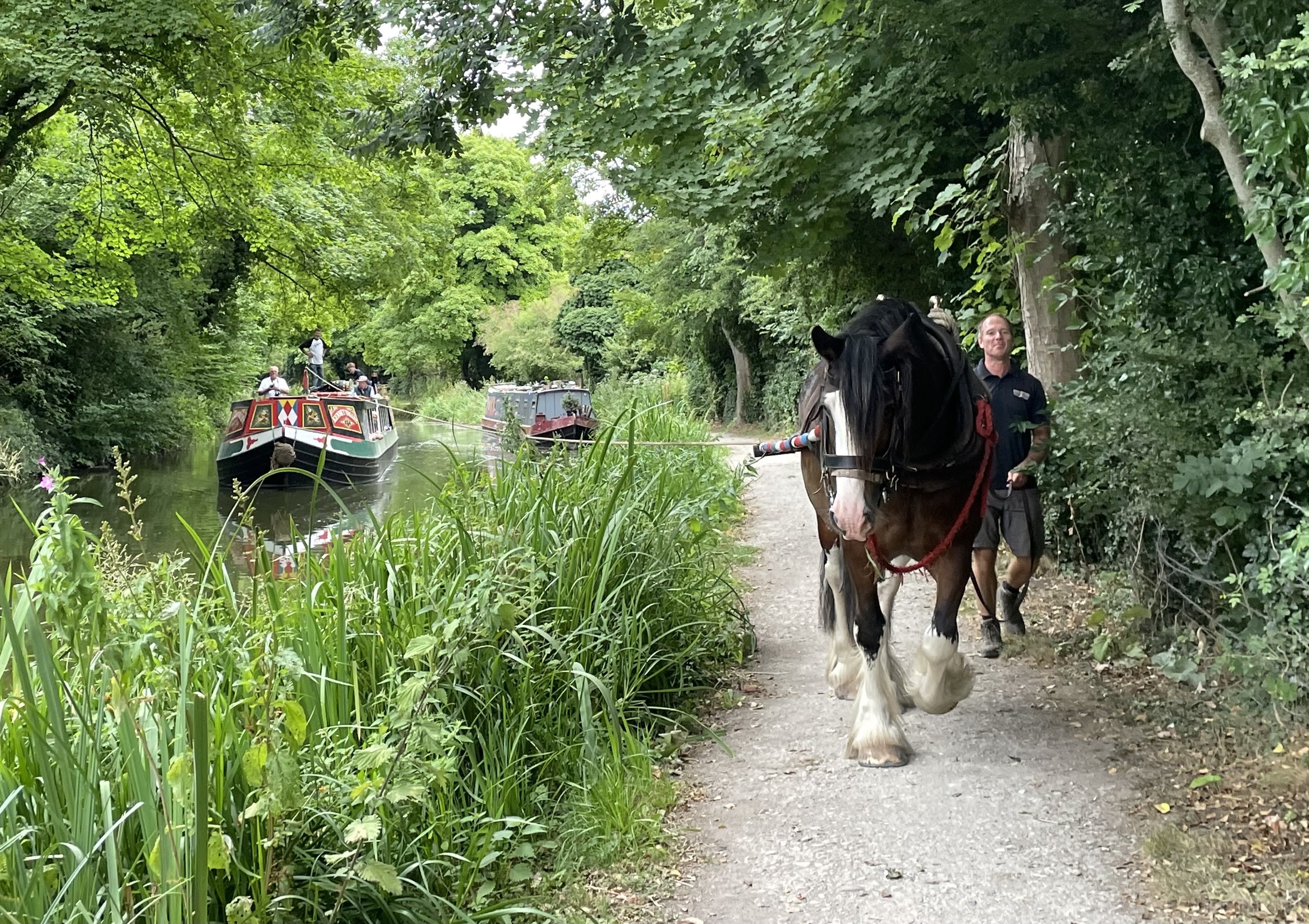
                                                        Can you spot the horse ahead?

To my surprise, I came across a large canal boat carrying dozens of tourists, being pulled by a shire horse - an old but painfully slow way to get around. 


I asked "Drummer's" handler whether the horse would feel tired lugging such a heavy load, and he replied, "no! It's just like when you go through the water", whatever that means!


I then walked across the ancient fields, still marked by medieval field boundaries, admiring the rolling hills and golden harvest ready to be reaped. 

I reflected on how generations of farmers would have ploughed on these fields and built houses around this historic village. 

I then walked through the village streets and came across some quaint cottages. 

                                                            White Lodge (on the right). 

White Lodge is a 17th century timber house that had been divided into two cottages. 

                                                                            Kennet House 

Kennet House would also have been familiar to the Fowles, having been built in the 18th Century. 

I walked back to the church and finished my tour there. I thoroughly enjoyed my walk through this quintessential country village so steeped in history. 


References: 

Interview with Gill Hornby: https://www.cambridgeindependent.co.uk/whats-on/gill-hornby-interview-the-literary-mystery-that-sparked-a-novel-idea-9104810/

Heritage walking tour of Kintbury: https://www.westberkshireheritage.org/wp-content/uploads/2016/07/Kintbury-Heritage-Walk-V2.pdf


Thursday, October 29, 2020

A Review of "Unmarriageable" by Soniah Kamal


While I don't usually read much fan fiction or spin-offs, I just had to get hold of Soniah Kamal's Unmarriageable, which is a South Asian take on Pride and Prejudice. Having lived in South Asia for 12 years and having got married there, I was sure that this rewrite would resonate with me, as I could relate to the characterisations and contexts - which I absolutely did. 

I feel that any of the Jane Austen novels would adapt well to South Asian literature and cinema, a topic which I will explore further in another post. There are so many similarities between Regency society and the social norms of contemporary South Asian culture. The marriage market, the stereotypical over-zealous, matchmaking mothers and aunties, the limited freedom of young women, marital gold diggers, societal taboos surrounding marriage and sex... it's all there in Pride and Prejudice - and in modern-day Pakistan (and elsewhere in South Asia). 

Many modern day South Asian girls battle with similar moral dilemmas to girls of Jane Austen's era, with pressure to marry a man of their parents' choice and to give up their careers after marriage. Premarital relationships would be unheard of and illegitimate children a definite no-no - which is why Mr Wickaam turns out to be a villain just like in the original story. 

This novel shows a modern, independent, free-thinking Elizabeth - young teacher, Alys Binat - who, like Elizabeth Bennet, isn't afraid to voice her opinions.  Alys, like her sisters, is under tremendous pressure from her mother, Mrs Binat, to marry and marry well. Soniah Kamal's Mrs Binat is very much like Mrs Bennet in P and P, hysterical, ridiculous, and in need of tranquillisers. Alys won't marry the rude, proud, snobbish Valentine Darcee - whose proposal she declines, as he is "unmarriageable". Neither will she marry the riciculous but wealthy, "suitable boy", Farhat Kaleen (Mr Collins). One of my favourite scenes in the novel is Mr Kaleen's proposal to Alys - very much like Mr Collins's - with his premeditated flowery phrases full of praise and pomp.

In Unmarriageable, Kamal really brings Jane Austen's spirit to life. The plot mirrors that of Pride and Prejudice and there are so many parallels between Alys' story and that of the original; the characters and their idiosyncrasies, the humour and wit, but there are also many South Asian references, which are very well explained to someone less familiar with the culture. In the first chapter, in her role as a teacher at an all-girls school, Alys discusses the role of women in Pakistani society -  a wonderful introduction to their world and the issues that girls and women deal with. After that, the story slows down a little and it did take me a while to get into the story, but it got much more interesting towards the end. 

There are several references to Pride and Prejudice in the book and, as Alys says (p.227), "we are... a society teeming with Austen's cruel Mrs Norrises, snobby looks-obsessed Sir Walters, and conniving John Thorpes and Lady Susans." I'm pretty sure you could find many a Mrs Bennet, a Lydia and a Mary Bennet in Pakistan as well! 

Tuesday, June 19, 2018

New in Chawton!

Yesterday I visited Chawton to participate in some Regency Week events, which are taking place all week this week. I love it how there is always something new and interesting to see whenever I visit Chawton. 


In the morning, I went on a fascinating Chawton guided walk, given by local historian Jane Hurst. The walk gave me so much perspective on how Chawton looked back in the day, who lived there, and what life was like there at the time of Jane Austen. I will share some of the details of what I learnt in a more comprehensive post later this week. 


I then decided to head towards Chawton House (formerly Chawton House Library) for lunch. On the way, I stopped at St Nicholas Church to see the small newly erected statue of Jane Austen. It very much resembles the one at Basingstoke Market Square, having been painted by the same sculptor, Adam Roud. 


It was wonderful to see a statue of her, book in hand, dress blown away in the wind, looking towards her beloved village of Chawton. While the Basingstoke statue was lifesize, this one is much smaller and has been placed on a beautiful pedestal that has a plaque in honour of Jane Austen. 


While being at St Nicholas, I decided to have another look at the Austen family graves and inside the church before heading to the Great House for lunch in their lovely old tearoom. I also attended the current exhibition the about Gothic novel there,  "The Art of Freezing the Blood". 


How Chawton House looked at Jane Austen's time when its exteriors were still white. 


The experience of visiting Chawton House has improved from my last visit when the House was still called Chawton House Library. There are more interesting snippets of information scattered in different parts of the house and I noticed that they also do a family trail these days - another excuse to bring the children one day! 

I learnt that Jane Austen loved to sit on this windowsill and look at the wonderful view of the driveway into the house. 

I had a lovely walk back to Chawton Cottage and had a look at my favourite place of pilgrimage before heading back to Alton. 

In Alton, I attended a speech given by Catherine Jane Knight, one of the last descendants of Jane Austen's brother, Edward, to live in Chawton House. In the speech, she described her life in Chawton House, what made it such a special place, and also described her personal experience of the decline of a great country manor, one of the several that saw their decline in the latter part of the 20th century. 


I thoroughly enjoyed her speech and the interesting slides she showed us of her childhood in Chawton House, and I even got my copy of her book signed. I recommend reading her book if you would like to know more about life in Edward Austen Knight's country house where Jane Austen often visited when her family were about. 


Friday, January 1, 2016

More to Read About the Festive Season in Georgian England


I hope you all had a wonderful Christmas and have enjoyed the festive season in your part of the world. I have enjoyed Christmas here in Hampshire, having visited Chawton for Jane Austen’s birthday and Bath after Christmas with my family.

On my visit to Chawton, I saw this book at a second-hand book shop window, and decided to treat myself to a little present.  Jane Austen’s Christmas – The Festive Season in Georgian England, is a collection of letters and excerpts from Jane Austen’s novels, compiled by Maria Hubert back in 1996.  The book cover had an attractive picture of Polly Maberly/Kitty Bennet of P & P 1995, and it just called out to me. As I knew a thing or two about the Georgian Christmas already, I was fascinated to find out if Maria Hubert had any interesting facts to reveal about Christmas in Jane Austen’s times.

I did not find the book a particularly exciting read, as the information is not presented in a very coherent or interesting way. However, the book does have a  good selection of letters from the Austen family and excerpts from her books that mention Christmas.

As we discover from Jane Austen’s Christmas, Georgian Christmas was a season of balls, parties and other kinds of entertainment. It was a time when families and friends would get together to dance, play games, cards, perform family plays, and eat well just as we do these days. We learn from the letters that there would be many guests and the party season could be quite exhausting for some.  In 1807, Jane wrote to Cassandra after the Christmas guests had departed, “When you receive this our guests will all be gone and going; and I shall be left to the comfortable disposal of my time, to ease of mind from the torments of rice puddings and apple dumplings, and probably to regret that I did not take more pains to please them all” (p. 38).

The book discusses the food eaten at Christmas and the social significance that the various types of food had at the time. For instance, while mutton was the most commonly served meat at the Christmas table, venison was a status symbol favoured by the very wealthy, such as Mr Knightley or Jane’s own brother, Edward, showing that one had enough parkland to graze deer. Turkey was also becoming popular at the Christmas table, as was the tradition of plumcake.

Various games, such as snapdragon, bullet pudding and charades are explained in detail in the book. The Christmas games make Jane Austen’s Christmas sound like a very jolly, playful time indeed! Jane Austen herself wrote some clever charades, which I will have to share with you soon.

As opposed to the contemporary Christmas, which is focused on spending and giving presents, the exchange of gifts was certainly less elaborate in the Georgian times. Presents were exchanged on December the 6th, in commemoration of St Nicholas, as in other parts of Europe. Jane Austen made a little Gingham needle bag for a departing friend in 1792 and wrote (p. 14),

This little bag, I hope, will prove
To be not vainly made;
For should you thread and needles want,
It will afford you aid.
And, as we are about to part,
‘Twill serve another end:
For, when you look upon this bag,
You’ll recollect your friend.  

Much of the gifting was centred around charity to the poor.  On Christmas Eve, 1798, Jane Austen writes to Cassandra, “I have given a pair of worsted stockings to Mary Hutchins, Dame Kew, Mary Steevens and Dame Staples; a shift to Hannah Staples, and a shawl to Betty Dawkins” (p. 25).

In Georgian times, Christmas ended on Twelfth Night, which was a grand celebration, often involving a ball. I have described the Twelfth Night celebration here.


With Christmas over and the New Year dawning, I now wish you all a very happy New Year and hope to be able to share many more stories from Hampshire in the coming year!

Wednesday, November 12, 2014

Pride and Prejudice Goes Graphic

Have you ever read Jane Austen in the form of a comic? Well, this was a first one for me, too! My husband attended a Comic Con recently and brought me this this Pride and Prejudice graphic novel.

IMG_0974

The graphic novel is written by Laurence Sach, illustrated by Rajesh Nagulakonda and published by Campfire whose mission is to “entertain and educate young minds by creating unique illustrated books that recount stories of human values, arouse curiosity in the world around us and inspire with tales of great deeds of unforgettable people.”  And having read the novel, I too feel that a graphic novel is a great way to introduce a classic to a young audience that might find the original a tad too challenging to grasp.

While I didn’t expect to like the graphic novel one bit, not being used to the genre, I was positively surprised to discover that this version has captured the essence of the novel so well. The graphic novel has stayed faithful to the original, changing nothing and removing nothing essential. The original language of the novel has been largely pertained, although the dialogue does remind me a great deal of the 1995 BBC P & P Miniseries; in fact, I’m quite sure that the authors have seen it and have based a large amount of the storyline on the TV adaptation.

IMG_1499

Captions have been added to the illustrations to explain the story clearly, and the thought bubbles add to the effect, showing us what each character thinks, which is obviously missing from Jane Austen’s original novel. This is a helpful effect in Pride and Prejudice in particular, as we can see how Elizabeth and Darcy’s feelings change throughout the story, making the story accessible to anyone.

IMG_1502

While the costumes and backgrounds in the illustrations look appropriate, the characters’ faces look chiselled to perfection, making them look super modern. Perhaps this can be forgiven, though,thanks to the style in this genre! The language, however, is not quite perfect in places, with some grammatical errors here and there and some slips, such as the title in Mr Lucas (for Sir Lucas).

IMG_1500

Nonetheless, Pride and Prejudice Graphic Novel is certainly a fun addition to my Jane Austen collection and I would recommend it to anyone who wishes to be introduced to the author. Funnily enough, my one-year-old daughter loves browsing through the book and looking at the pictures…I’m hopeful that she’ll grow up to love Pride and Prejudice one day as much as I do!