Search this Blog

Thursday, August 15, 2024

"There is real beauty at Lyme; and...altogether my impressions of the place are very agreeable."


Thus says Anne Elliott in Persuasion when she thinks back on her time at Lyme Regis. Seaside resorts were all the rage during Regency times, and the Austen family frequently visited resorts such as Lyme for their healing sea waters. Lyme Regis was a huge inspiration for Persuasion, and I have always wanted to visit there; I wasn't disappointed when I finally made it there last weekend. 


The sea views and views across the cliffs of the Jurassic Coast are stunning. 


Much of Lyme Regis has been preserved from the Regency times - in fact, there are several buildings that would have existed during Jane Austen's times. 


Jane Austen is believed to have stayed at this cottage at Pyne House, 10 Broad Street, when she visited Lyme in 1803 and 1804. 


The cottage is situated close to the seafront in a bustling street with several shops and restaurants. 


The seaside promenade was one of the first of its kind, created in 1771. The promenade is lined with pretty pastel-coloured cottages, such as these guesthouses. 


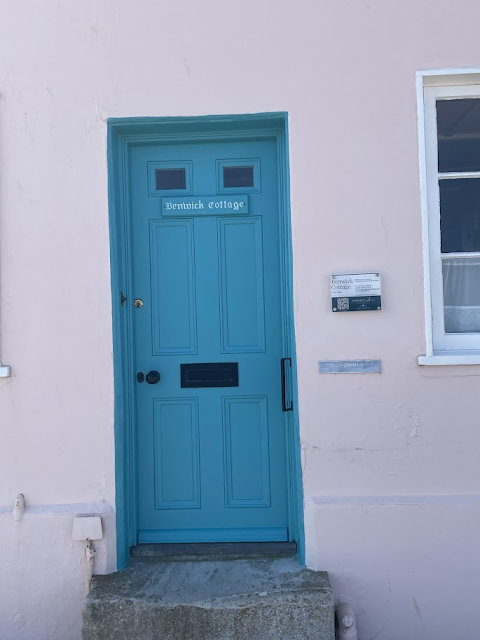
Wouldn't it be charming to stay with the Harvilles and Benwicks in these pastel pink cottages? 


I enjoyed browsing the Jane Austen Collection at the Lyme Regis Museum close by.  Several Jane Austen-related items that have been donated by a family member called Diana Shervington. I would love to know more about their authenticity.


This coquelicot-coloured cockade really caught my eye. Feathers and ribbons in this shade of red were fashionable after Nelson's triumph over the French at the Battle of the Nile, and this feather probably came from an egret - a heron common in the Nile Delta. This cockade is said to have belonged to Jane Austen, and I can well believe that it did; in 1798 Jane wrote in a letter about an evening cap that she was altering, "I still venture to retain the narrow silver around it, put twice round without any bow, & instead of the black military feather shall put in the Coquelicot one, as being smarter; - and besides Coquelicot is to be all the fashion this winter." (p. 26, Letters).


These glasses are said to have belonged to Cassandra Austen, Jane's older sister. They remind me of Jane's ones, which I have seen on display at the British Library. 


The gaming pieces, on the other hand, remind me of the humiliating episode at Box Hill! 


The Museum is situated in the building where the famous fossil hunter, Mary Anning, had her shop. I am fascinated by her life and had to visit her statue around the corner - I will share more about her in another post. 


No visit to Lyme Regis is complete without a walk on the Cobb. 


The walk was so pretty with the water glinting in the August sunshine. 


I also had a go at climbing down Granny's Teeth; in Persuasion, Louisa Musgrove, of course decides not to walk down these treacherous steps but tries to jump into Captain Wentworth's arms, only to fall onto the hard floor below with dreadful consequences!


I was amused by the fact that there was a warning sign at the bottom - perhaps this would have helped poor Louisa Musgrove! 

References: Le Faye, Deirdre. (2011) Jane Austen's Letters. Fourth Edition. OUP. 


Friday, June 28, 2024

Join me on a Guided Tour of Alton


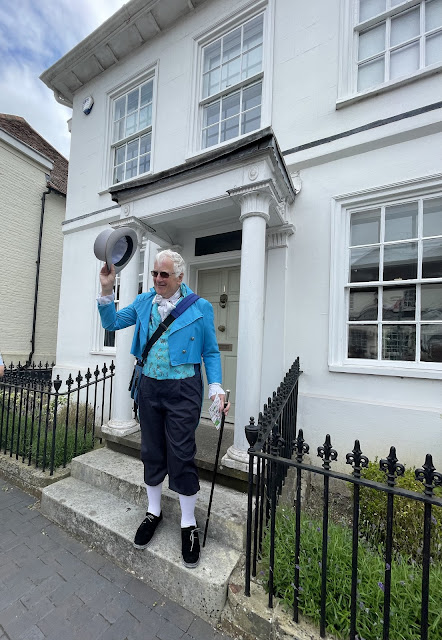
It is Regency Week again and time to return to Alton for Regency Day. You may have read my previous, independent tour of Alton, and this time I decided to take a guided walk as part of the programme. I will take you on this guided tour today!

Alton is a small market town within walking distance from Chawton where Jane Austen spent the last years of her life. Jane would often walk to Alton to meet friends, shop, pick up post or board a carriage to London. 


We met our entertaining and knowledgeable guide, Bob Bookers, who started the tour from 1 Normandy Street - Hill House - the home of William Parker Terry. Jane would often dine with the Terry family of Dummer, close friends of the Austens.

We then crossed the road and saw William Curtis' house at 4 High Street (above). William Curtis was a surgeon apothecary, whom Jane Austen affectionately called "the Alton Apothy". He tried to cure Jane Austen during her final illness, but sadly he was unable to find a cure, and Jane Austen travelled to Winchester in search of a better treatment where she later passed away. I wrote more about William Curtis in this blog

6 High Street, was the home of James Battin Coulthard. In 1813, Jane wrote, "The Coultharts were talked of you may be sure; no end of them; Miss Terry had heard that they were going to rent Mr Bramston's House at Oakley."

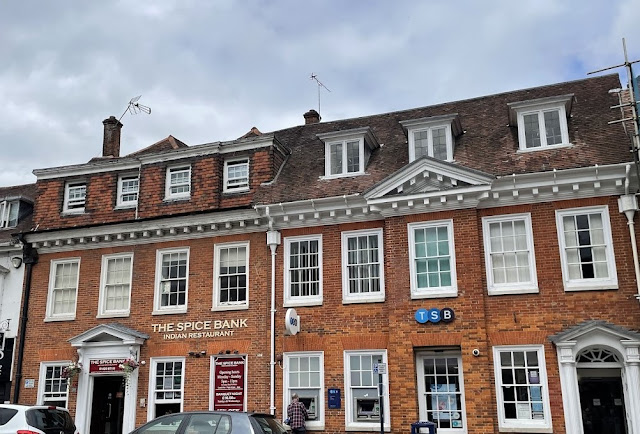
Number 10 (above) housed the bank of Austen, Grey and Vincent from 1806-1812, the Austen being Jane's brother, Henry. Henry started off his career in the army and then moved onto banking, which ended disastrously in bankrupcy, leading on to a further career change into the clergy. Henry's bankrupcy was a huge financial blow to the Austen family. 


Number 40 (left) was occupied by Richard Marshall, who sublet his farmhouse to the Lefroy family. You may be aware of the Irishman Tom Lefroy, with whom Jane Austen had a brief flirtation at the age of twenty. 

Number 42 (right) was the home of Thomas Clement, an attorney who married the niece of the naturalist Gilbert White. Thomas' son married Jane's neighbour, Ann Mary Prowting in 1811, and in 1813 Jane wrote: " I went with (Mrs Clement) and her Husband in their Tax-cart; - civility on both sides; I would rather have walked, & no doubt, they must have wished I had". A typical example of Jane's rather sarcastic humour!


The Swan Hotel occupies number 29. This is where Jane would board a stagecoach - Collyer's Coach - for London and Southampton. In Southampton, I recently noticed a sign saying that it would take 10 hours to reach Alton by stagecoach. Our tour guide informed us that the journey to London would have taken 6 hours. In 1814, Jane wrote to Cassandra, "I must provide for the possibility, by troubling you (to) send up my Silk Pelisse by Collyer on Saturday." This very pelisse (overcoat) is now on display at the Jane Austen House Museum. 

The oldest house in Alton is situated at 8 and 10 Turk Street. There are guided tours into the house every third weekend of each month.

Lansdowne House at 74 High Street (covered by market canopies on Regency Day) was the home of apothecary and surgeon John Newnham. Jane does not seem to have been impressed by this doctor, as she wrote a mocking poem about her visit to his house in 1811. This is one of the most beautiful buildings here, with gorgeous architectural detail at the top of the building. 


Being a market town, the Alton market was held at the market square every Saturday.


Many of these buildings were known to Jane Austen. 


This building above is the oldest commercial establishment in Alton, dating back to the 1500s.


The town hall dates back to 1813, and Jane would have been familiar with it.  

We then walked on, and came to this house where the poet Edmund Spencer, who wrote "Fairy Queen", lived in the 16th Century.  

The River Wey runs through Alton, and this is where watercress was grown - so famous in this area and rare elsewhere. 

The Church of St Lawrence is medieval, dating back to 1070. 

 
This is where Jane's brother, Henry Austen, officiated after Jane's passing from 1817 to 1818 and, according to our guide, her oldest brother, James Austen, also preached here. 


The Terry family - good friends of the Austens, as mentioned earlier - have a vault and a memorial plaque here. 


Interestingly, I walked past this memorial plaque to someone with the surname of "Steele"! Jane may well have been inspired by this name at some point in time, although she wrote the initial drafts of Sense and Sensibility in Steventon. 


A medieval feature still remains: colourful wall murals from the 15th Century, depicting the bishop, Thomas Beckett, who died a martyr. 

Lastly, we walked past Gill's Almshouses, which provided housing for the poor. The famous magistrate and captain in Cromwell's army, Thomas Gill, built these houses. The almshouses consist of eight flats, and housing is still offered to those living in Alton who cannot afford a home. 

If you would like to read more, please refer to local historian, Jane Hurst's, excellent guidebook. 

For references and further reading: Jane Hurst: Jane Austen and Alton.  


Thursday, June 27, 2024

Another Exciting Regency Week!

Alton Regency Week - one of my favourite events of the year - started off with the traditional Regency Market last Saturday. The atmosphere was quiet but festive, with tempting stalls, carriage rides, Morris dances and guided walks. It was wonderful to see so many in costume, enjoying the sunny day in gorgeous Alton. 


It was lovely to meet many friends, old and new, admire their gowns and bonnets and and share our news. 


Jenny Colquhoun was back with her fluffy friend, Freddie Wentworth, who was smartly attired in uniform as he always is! 


Hazel Mills had been busy sewing gowns and reticules besides industriously writing her detailed, fascinating posts in "Jane Austen Daily" on Facebook. 


The Jane Austen Literacy Foundation was represented by Carla Balakgie and Julia Grantham - sadly its founder, Caroline Jane Knight, was not able to make it this year. 


Sophie and Abbie had a great selection of Indian-inspired accessories for sale this year. 


Some of the shops had fantastic window displays up.


This year, I decided to learn more about the local history of Alton and join a guided walk by Bob and Carol. It was fascinating, very informative but also very entertaining. I will take you on my tour in my next post. 


I spotted this cafe during my walk! Needless to say, it was very busy on the day. 


On Sunday, I joined the annual charity walk from Jane Austen's House to Chawton House, in aid of the Jane Austen Literacy Foundation. I always love being part of this event to support such a worthy cause. 


 We assembled near the Jane Austen statue for a group photo. 


A short walk across the field to the barn where our picnic was held. Jeremy Knight, a descendant of Jane Austen's brother, Edward, told us that he had salvaged the building from a local Sainsbury's car park, and what a fitting location for an old barn this field is!


Jeremy, Carol and Paul Knight in the barn. 


Local author, Zoe Wheddon, came to talk about her new book, "Jane Austen: Daddy's Girl", which describes the huge influence that George Austen had on Jane Austen. I enjoyed Zoe's earlier book, "Jane Austen's Best Friend", where Zoe explored Jane's relationship with her closest friend, Martha Lloyd.


Zoe Wheddon with Sophie Andrews ("Laughing with Lizzie") and Abbie. 


Our lovely host, Carla Balakgie.


Judges Tony Grant (blogger of "London Calling") and author Helena Kelly, announced the winner for this year's Short Story Competition: Ann Evans who wrote "The Dawn Chorus". This was followed by Ann's lively reading of her cleverly written short story, which delighted us all.  

 
Hazel Mills then entertained us with her detailed stories about Jane Austen's contemporaries. So captivating - one even had a Poldark connection! 

An altogether enjoyable day in great company!