Search this Blog

Thursday, July 21, 2016

A Walk Through the Neighbourhood of Fanny Price in Portsmouth

It was a beautiful, sunny summer's day and we decided to venture back to Portsmouth as we had purchased a season ticket for the Old Naval Dockyard on our previous visit to see HMS Victory. Sadly, the fascinating Mary Rose exhibition wasn't open yet, but we enjoyed a lovely stroll along the sea promenade and a walk through the old town. 

The Portsmouth of today is really a mismatch of the old and new, but fortunately the old town has retained many of the Georgian and Victorian facades and some of the streets must still look the same as they did in Jane Austen's times. 


At the time, Portsmouth was a military and naval town of some 7000 people. The High Street had several handsome Georgian houses, which would have been homes to the wealthy, while the poorer, dirtier areas were outside of the main thoroughfare. Georgian Portsmouth was a noisy, filthy place and its inhabitants less sophisticated than what Jane Austen was used to. Quoting Fanny Price “The men appeared to her all coarse, the women all pert, every body under-bred” (MP, p. 395). Portsmouth was a haven for drunkenness and riotous and immoral behaviour. 


Walking along the streets of the old town, I started browsing the houses, imagining with my mind's eye which one would belong to Fanny Price's family...

We passed the beautiful, old Portsmouth Cathedral with a golden ship for a windwane. 


Nelson's presence is still felt in Portsmouth. The George Inn, which was destroyed in the Second World War, was a popular resting- inn for the leading naval officers and Nelson often stayed there. He had his last breakfast here before embarking on HMS Victory. 


The man himself. 


The roofless ruin of the medieval church, Domus Dei, or Royal Garrison Church, is at the seafront. This church was also destroyed in the Second World War. This is where Fanny Price worships. 


“The Prices were just setting off for church … when Mr. Crawford appeared again …. he was asked to go with them to the Garrison chapel, which was exactly what he had intended” (MP, p. 408).

“In chapel they were obliged to divide, but Mr. Crawford took care not to be divided from the female branch; and after chapel he still continued with them, and made one in the family party on the ramparts” (ibid.)


The ramparts completely surrounded the land, and it is on these stretches that Mr Crawford and the Price family would walk. “It was [Mrs. Price’s] public place; there she met her acquaintance, heard a little news, talked over the badness of the Portsmouth servants, and wound up her spirits for the six days ensuing” (ibid.).


One of the several memorials to sailors to be found in the port. 

What did Jane Austen think about Portsmouth? To be sure, it was a rough place, a place not fit for fine ladies. As the female villain of Mansfield Park, Mary Crawford, says,  “My dear little creature, do not stay at Portsmouth to lose your pretty looks.  Those vile sea-breezes are the ruin of beauty and health” (MP, p. 416). But as we know, Jane Austen loved the sea and the sea-breeze - however, she would certainly have preferred a seaside resort like Lyme Regis to the vices of Portsmouth. 


References and further reading: 
Honan, P. (1987). Jane Austen – Her Life. Bath: Phoenix Giant.
Thomas, B. C. Portsmouth in Jane Austen's time. Persuasions #12, 1990. 
Honan, P. 


Friday, June 24, 2016

Insights into Regency Fashion - Alton Regency Week

Did you know that paddings were used to accentuate certain body parts as early as Regency times? That women would use shoulder paddings to puff up their upper arms and men would accentuate the bulging muscles on their thighs using paddings underneath their light, figure-hugging pantaloons? 

You hear about women of the Regency period making shirts for their husbands and brothers, but did you realise that they also made shoes for themselves or their children?

Well, neither did I, but I learnt some interesting details about Regency Fashion as I attended a talk on Fashion of the Regency Period yesterday at Chawton House Library


The talk was one of the many interesting events held during the Regency Week in Alton. I would have loved to participate in all of them, but being a busy mum, I only had the chance to attend one of the events. Having written a blog about Regency Fashion before, I opted for the talk on fashion as I was curious to see if I could learn something new and get a glimpse of some authentic Regency fashion accessories. 

The informative talk was given by Dr Kathrin Pieren, curator at the Petersfield Museum and a history fellow at Southampton University. Dr Pieren began by describing the political background and the earlier, highly frilly and decorative rococo fashions. She explained how the radical changes brought about by the French revolution and the Napoleonic wars influenced the fashion, the constrictive corsets and crinolines giving way to the more practical, free-flowing statue-like dresses in the style of Roman statues and military styles. Using various images from the Petersfield Museum collection amongst others, Dr Pieren also demonstrated the significant influence that the Prince Regent and the fashion icon, Beau Brummel had on the fashions of the day, and how the fashion gradually changed back towards more restrictive styles after the end of the Regency period. 

The highlight of the talk was the brief display of fashion accessories that Dr Pieren had brought from the Petersfield Museum collection. 


This embroidered gentleman's silk waistcoat from the 1770's is exquisite, with beautiful detail and shiny fabric. The earlier fashions were much more elaborate and the waistcoats were still visible,  as opposed to later on in the Regency period when the light-coloured waistcoats were plain and hardly visible, worn under a the dark coat. 


The later waistcoats were a lot shorter, like this one worn after the Regency period. 


Walking sticks were an important accessory for Regency gentlemen, giving them a sense of stature as well as something to hold and "play with". This black example has an ivory dog carving as a handle. 


These Regency ladies' shoes puzzled me as they seemed quite tiny and narrow. Were people really much smaller than us back then? The shoes remind me of Jane Austen's glasses which were absolutely tiny and looked like something a 7-year-old might wear. The shoes do look comfortable, but not particularly long-lasting, and I assume that ladies must have spent a great deal of time mending as well as making shoes. 


This beautifully embroidered, sheer child's dress is extremely light and made of white Indian muslin as per the fashion of the Regency period. The material reminds of the dresses that I have seen worn by ladies in India even today. Muslins were the order of the day, but it does make you wonder how ladies and children survived in these materials throughout the cold English winters. To be sure, there were layers of undergarments underneath, but it must have been a relief to wear heavier garments (with more restrictive undergarments however) in the Victorian era. 

Petersfield Museum has a Historic Costume Gallery and it would be lovely to go and see the entire collection on display at the museum. 

At Chawton House, I also bumped into fellow blogger, the lovely Sophie Andrews of the Laughing With Lizzie blog (in the blue spencer) and her friends who have formed The Jane Austen Pineapple Appreciation Society (!!), all in costume. It was lovely meeting the young ladies and sharing our passion with all things Jane Austen and Regency!


Some lovely photo opportunities later, I was sad to leave the beautiful Chawton House, basking in atmospheric midsummer's evening sunshine, but pleased to have finally made it to Regency Week. 


Saturday, June 18, 2016

Following the footsteps of the Austen brothers in Portsmouth

Over the Easter holidays I travelled to Portsmouth with my family to visit the naval dockyard and in particular, the old battleships, HMS Victory and HMS Warrior. Jane Austen's brothers, Frank and Charles, were sailors, working on similar ships, as were several of Jane Austen's characters, most notably Captain Wentworth (Persuasion) and Fanny Price's brother William (Mansfield Park). 


Through her brothers, Jane Austen herself was very familiar with naval life and took a keen interest in her brothers' work, and it therefore comes as no surprise that she has used the setting so extensively in her novels. She held an admiration for the navy, and Frederick Wentworth is inarguably one of her most attractive, masculine characters. It was fascinating to get a glimpse into the world of the navy of her time and get a close viewpoint of how life was onboard and on the docks.

HMS Victory.


HMS Victory is, of course, one of the most famous battleships of Jane Austen's time, used by Nelson in the Battle of Trafalgar, the decisive sea battle against the French in which the famous admiral was shot and killed in 1805. Nelson was hugely admired and praised at the time, and Frank Austen was excited to serve under his command. Frank was upset to have missed the Trafalgar action, as he had only just been commanded elsewhere, and he never quite ceased to be disappointed. No doubt, HMS Victory must have been very similar to the boats on which Frank served.


HMS Victory is beautifully built and well maintained. The low ceiling and slanted floors of the captain's quarters, or "The Great Cabin", give an antique feel to it, in comparison to the newer Warrior. 


The living conditions were certainly better for the captain and his commanders than the sailors down below. 


The conditions on the Lower Gun Deck below were very cramped. It is dark, the ceilings are lower, and as you can see, it is difficult to get a good photo in the dim conditions. There was just a tiny hammock space allotted to each sailor, with cannons between the cots.There were 450-600 sailors dining and sleeping on the deck at the same time, and the arrangement hardly allowed any privacy. 


The food prepared in the Galley was basic but high in calories, mainly consisting of boiled beef or pork with vegetables or dried fish. Animals were kept on board for meat. The meat was salted down in casks to preserve it.


While HMS Warrior is a newer ship, built in the 1860's, seeing the interiors of the ship would give you quite a good idea of life on board. The captain and the commander's quarters were quite livable, although they were not very large. Naval life must have been very ascetic indeed back at the turn of the century, when the facilities on board were so much more basic.

Life on board was no plain sailing (excuse the pun!). Sailors often suffered from seasickness, Nelson himself included. "Decks could be like wet porous stone with dampness below in every hammock. The hacking cough of men echoed in every hour of the watch. More men died of tuberculosis than were killed by shot, and other diseases...were common" (Honan, p, 160-1.)

However, you couldn't afford to be lazy; there were brutal punishments for inefficient sailors and even the young officers in training. Flogging was commonplace. "You faced the grating with tied wrists as bosun's mates flogged your back into livery pulp. Twenty lashes for minor naval infringements were common: fifty exposed your bones. When three sailors were sentenced to 400, 500 and 600 lashes in this harbour, mates flogged at upright corpses" (Honan: p. 2).

Bloodshed was obviously part of the business, and on the Orlop Deck where wounded sailors were taken for medical assistance, there were some gruesome details on display, such as an amputated leg and some bloody instruments.


Having seen the ships, you realise that running a large ship like this must have been a mammoth task. It took hundreds of men just to lift the anchor, let alone run the machinery. It would also take a very efficient and powerful captain to run a ship and make it successful. As I was listening to the guides' stories about the ships, it made me realise just how powerful a person a naval captain would be. He would be in charge of literally hundreds of sailors and could basically do just as he pleased. He was an authoritarian head who would decide the fates of all these men and their families.


Walking down the decks, I imagined myself an Anne Elliot on board with her Captain Wentworth. Seeing the ships helped me understand the story behind Persuasion better. Being a captain was certainly a glamorous job at the time, and one could understand why Anne "gloried in being a sailor's wife". With his newly acquired prize money and fancy title, Captain Wentworth would be a thousand times more presentable in society, a powerful figure and a military hero that people would look up to - Anne Elliot not the least.

However, as I recall Mrs Croft's stories in Persuasion about life on board, describing how wonderful it was to accompany her husband, Admiral Croft, on board, it is hard to imagine anything glamorous about naval life. There was a lot of hardship in terms of food, health and general comfort, and to be one of the only ladies surrounded by hundreds of men through episodes of bloodshed, drunkenness and foul language, it baffles me how the accompanying wives coped from day to day. It reminds me of the scene in Persuasion where Captain Wentworth argues with his sister, Mrs Croft, claiming that a battleship is no place for a woman: "I hate to hear of women on board, or to see them on board; and no ship, under my command, shall ever convey a family of ladies any where, if I can help it." (Ch. 8)

Yet, this was the life that Jane Austen knew inside out and romanticised about; as described by her nephew, James-Edward Austen Leigh, "with ships and sailors she felt herself at home" (p. 18).


References: 

'Austen-Leigh, J. E. (2002) A Memoir of Jane Austen and Other Family Recollections. Oxford World Classics.

Honan, P. (1987) Jane Austen - Her Life. Phoenix Giant. 

Sunday, May 29, 2016

Review of Love and Friendship

Love and Friendship, the film adaptation based on Jane Austen's novella, Lady Susan, was released in the UK this week.

 Unfortunately, the film is only showing in a handful of cinemas and for a very short period of time, which urged me to travel a long distance to catch a rare viewing of this long-awaited adaptation. 


As I mentioned in my earlier post, the film was directed and produced by Whit Stillman, the producer of Metropolitan (a modern remake of Mansfield Park). Having enjoyed Metropolitan, I had fairly high expectations for Love and Friendship, and I couldn't wait to see how Whit Stillman had managed to adapt the Georgian style epistolary novella onto big screen. 

Stillman's biggest challenge must have been the screenplay - how to to transfer the story, entirely written in letters, into well-flowing dialogue and narrative. I was pleased to see that the film has stayed faithful to the original story and very much responded to my own imagination of the characters, the setting and so on. The worst thing is to see a favourite novel changed dramatically when adapted onto screen, but this wasn't the case with Love and Friendship. 

The film correctly portrays Lady Susan (played by Kate Beckinsale), a widower, to be an attractive, charming and intelligent lady, whom we later discover to be a manipulative, selfish person with a lack of empathy for others - this is particularly shown in her interactions with her friend and confidante, Mrs Johnson (Chloe Sevigny). Overall, the film is very well cast, Beckinsale making a credible Lady Susan, perhaps thanks to the fact that she has previously played another less likeable Jane Austen character, Emma (1996), and is clearly quite comfortable with the lengthy, archaic dialogue. Lady Susan's young suitor, Reginald DeCourcy (Xavier Samuel), his parents (James Fleet and Jemma Redgrave) and Lady Susan's suppressed daughter, Frederica (Morfydd Clark), all corresponded to the characters I had created in my mind while reading the novella. 

While there is very little scenery in the film, I enjoyed the period-style string music playing in the background, the beautiful Georgian interiors and exteriors and the shiny, silky costumes (which actually create a brushing sound as the actresses move around the room), not to mention the high Georgian hairdos with flowing curls. However, I thought that some of the male characters, perhaps, looked a little too modern, and should have had long hair tied up in a pig tail, like the Austen brothers did at the time. 

At the beginning, the characters are introduced posing and what Stillman calls "arch intertitles". There are several characters in the novel and this was probably done to make it easier for the viewers to follow the plot. I would have preferred it if the characters had been presented in a more "natural" way, as they were presented in Pride and Prejudice - a servant announcing their names, as they entered the room, for example. I also thought that the beginning of the film could have been a little more dynamic - I was actually looking forward to a more dramatic entrance of the main character, Lady Susan.

While the beginning is a little stiff in parts and had me yawning a few times (very unlike me during an Austen film!), the film does improve towards the end. The film clearly caters to a more learned, connoisseur audience rather than the general masses - being an independent film-maker, perhaps Stillman has not aimed at a wider distribution of the film, allowing him to take some interesting creative liberties. However, I would like to see the story popularised to make it known to the wider world, but this would require some simplification of the story, more dynamic changes of scene and some more theatrical characterisation. There are a few deja-vu characters typical of the Jane Austen adaptation, such as Frederica's suitor, Sir James Martin (Tom Bennett), who borders on the ridiculous in the style of Mr Collins (Pride and Prejudice), and the theatrical Mrs Manwaring (Jenn Murray). 

While the adaptation stays very faithful to the original, there are some very interesting twists to the story at the end, including an adulterous Lady Susan, clearly added in for entertainment value. I will not narrate the story or reveal the final twists at the moment as I don't want this review to be a spoiler. The film is very much centred around the brilliant dialogue and I would certainly recommend seeing it if you enjoy all of Jane Austen's works and yearn to see more. 


Tuesday, May 3, 2016

"They had a very fine day for Box Hill"


"They had a very fine day for Box Hill", wrote Jane Austen in the seventh chapter of Emma. While many of Jane Austen's locations are imaginary, this important, dramatic scene takes place at a location that still exists with the name of "Box Hill". 

As we had a very fine day, we decided to drive to Box Hill with my family. I have been wanting to visit Box Hill for a long time, and was really pleased to visit the famous picnic spot on such a lovely, sunny day. 

Box Hill is situated between Leatherhead and Dorking amidst some of the most beautiful countryside of Surrey - called "an Area of Outstanding Natural Beauty". 

It is easy to imagine horse carriages along these the old, narrow zig zag roads that lead up to top the hill. 


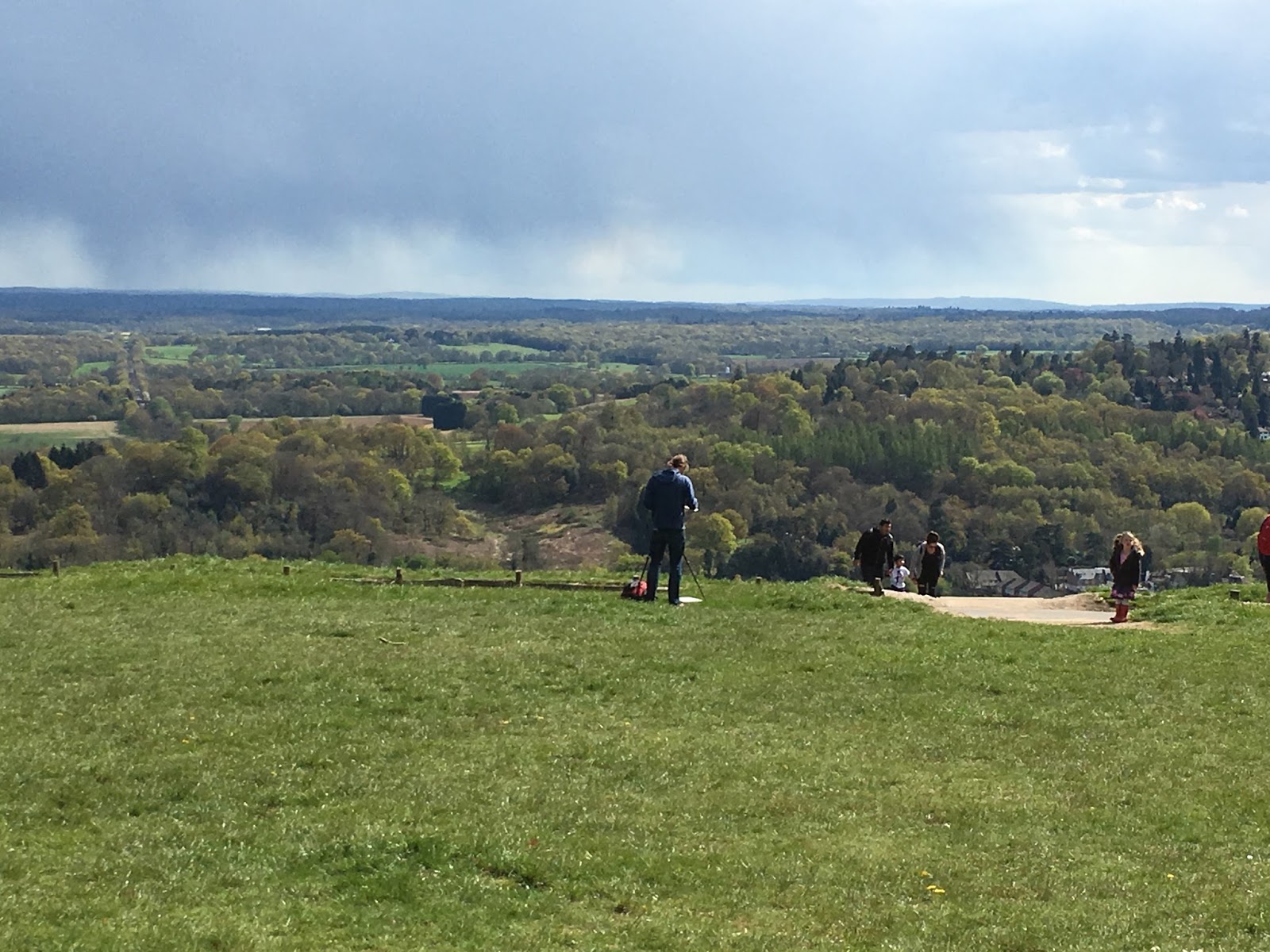
The views from the top of the hill are phenomenal and present a gorgeous panorama over the beautiful Surrey countryside. No wonder the place is still popular with picnickers - a lovely place to admire the views or to paint a landscape (as below).


Picnics have been popular ever since the beginning of the 19th Century, although they must be a great deal simpler to organise these days. In Jane Austen's days, it must have demanded a great deal of labour, cooks and servants, to deliver a wholesome picnic. These days, Box Hill is a popular tourist site owned by the National Trust with walking tours and family trails amongst other activities. 


Jane Austen was obviously familiar with Surrey, frequently travelling through the county to London to visit her brother, Henry, in London and Edward in Kent. On the way, she sometimes called on her mother's cousin, Cassandra's family in Great Bookham. Cassandra had married the Reverend Samuel Cooke, who was rector of Great Bookham from 1769 to 1820. He was Jane's godfather and the Austens were close to the family.

Interestingly, Jane visited Great Bookham in June, 1814, the year when she had started writing Emma. During this visit, she might have got inspired to set one of the most important scenes of her novel on Box Hill. Perhaps, like Emma, she visited Box Hill and was "in tranquil observation of the beautiful views beneath her". While I am partial to Hampshire (for obvious reasons), I must say that I have fallen a little in love with the Surrey countryside as well. 

Of course, the midsummer picnic starts with a "very fine day, and all the outward circumstances...were in favour of a pleasant party", but as we know, the party ends in a disaster, with Emma not the least to blame. The Box Hill episode shows her the strength of her power over others and humbles her down. Badly done Emma.


References and further reading: 

Chapters 6-7 in Jane Austen's Emma.

Edwards, A-M. (1991) In the Steps of Jane Austen - Walking Tours of Austen's England. Wisconsin: Jones Books. 

Picnicking on Box Hill in Jane Austen's World 

Box Hill in Jane Austen's Emma in Jane Austen in Vermont