Search this Blog

Saturday, April 9, 2016

Finally at Chawton House!


Whenever I visit Chawton Cottage, I feel like I have stepped back in time for a day. It felt exactly like that when I visited Chawton House Library or, "Chawton Great House", as it used to be called. I believe that the house still looks very much as it did in Jane Austen's times, although it is an even older building, dating back to the Elizabethan times. 

 
I have tried visiting Chawton House a few times before, but never managed to be there at the right time. I was so pleased to gain entry and to have a thorough look through the house. I was able to take some photos of the house, but I do apologise for the quality of the photos, as I only had my mobile phone camera on me. 

The manor was owned by Jane Austen's brother, Edward Austen-Knight, who lent it out to gentlemen tenants but also spent a great deal of time here himself . He divided his time between his two estates, Godmersham in Kent and Chawton, and thanks to his position as a wealthy landowner in Chawton he was able to provide a home for his mother and sisters in Chawton. Jane Austen was obviously very familiar with Chawton House and visited there regularly for dinners. 


These days, the manor serves as the Centre for the Study of Early Women's Writing from 1600 to 1830. The centre houses a vast collection of early women's writing, open to the benefit of scholars from across the world. There was an exhibition on, called Emma 200, dedicated to the 200 years since the publication of Jane Austen's Emma. It was a fascinating exhibition and I had a brief look through - I will share some photos soon. 


The house was built in 1580 by John Knight, an ancestor of Thomas Knight (picture below), who adopted Edward Austen and made him his heir. 


  Jane Knight, wife of Thomas Knight.
                                   
 These coats of arms show all the proprieters of the estate - the Knights.


Interestingly, Edward's coat of arms has a small red square at the top left, indicating that he was not a real "Knight" but was given the name through his adoption, and all his descendants have the same symbol in their coats of arms, too. 


As you enter the house, you come through to the Great Hall on your left. It is an impressive room and has retained its original Elizabethan wooden panelling. 


Dark panelled hallways take you from one room to another. 


In this dining room, you can imagine Jane Austen enjoying lengthy dinners with her family whenever Edward was in Chawton.


In the dining room, there is a portrait of Edward Austen-Knight, made during his Grand Tour of Europe. 


There is also a touching memento, a well-preserved jacket on display, which used to belong to Edward Austen when he was a young boy. It is easy to believe that the jacket belonged to him, as the jacket is very similar in style to the one in the portrait, with a similar cut and equally large buttons.


There were also several other familiar images of the family members on the walls, including that of Elizabeth Austen, Edward's wife (sorry about the poor picture quality). 


This is an image of Edward Austen Knight's Godmersham estate. 


The view from the dining room window. 


As you go upstairs, there are some beautiful heavy tapestries and some original William Morris wallpaper that was discovered during the restoration of the building in the nineties. 


I loved the Library, an intriguing place where you could imagine the gentlemen sitting down, writing letters and having a drink. 


The library is full of good novels and even a secret cupboard, perhaps used as a bar?


There are some beautiful windowsills upstairs that call out for a little rest and a look at the lovely views of the surrounding countryside. 


This old printing press is fascinating. It takes a relatively small machine to produce tons of books. 


During his time in Chawton, Edward Austen had a servants' passage built downstairs for privacy and safety. 


The passage takes you to the old kitchen, which has retained its old stone flooring and an 18th century worktable, although the range was acquired in the Victorian times. 


Behind the kitchen, there is a scullery, which now houses a bookshop. There are two original sinks in the room, which would supply water from a nearby well.


Here is a view out to the inner courtyard...


...and out to the garden. 


There is a Regency walled garden, designed in the style adopted by Edward Austen after the death of Jane Austen. However, I did not have the time to have a closer look at the gardens - something has to be left for next time! I enjoyed the views over the beautiful Hampshire countryside that surrounds the Great House. 


Monday, March 28, 2016

The Real Jane Austen - A Life in Small Things


I have recently added a gem to my Jane Austen biography collection: the acclaimed "The Real Jane Austen - a Life in Small Things" by Paula Burne (back in 2014). Now why didn't I get hold of this book before? Perhaps I was prejudiced by the whole heated discussion that took place around Jane Austen's portrait a couple of years ago. Not enough evidence was found to prove that the portrait on the cover of the book, belonging to Paula Burne, was authentic and I just sort of assumed the book to be superficial. 


But what I didn't realise was that Paula Burne has actually written a very clever biography in an entirely innovative style; instead of writing a conventional style biography in a chronological manner, she has written a collection of 18 essays on objects that somehow relate to Jane Austen's life, such as her writing slope, and attempts to highlight Jane's character through those. The essays are captivating, and the strength of this biography really is in the detail. 

Paula Burne has carried out immense research into the topic and brought out details about Jane Austen's life that have not been delved into in previous biographies. For example, as opposed to the popular opinion of Jane Austen being stuck to her country village and seeing little of the world, Paula Burne shows that Jane Austen was actually very well travelled for someone of her time, detailing the places where she holidayed and visited her friends, family and publishers. Referring to Jane Austen's connections in East India, the slave colonies in America and napoleonic France, Burne shows that Jane Austen had a wide view of the world and strong opinions on the heated topics of her time, such as slavery. She spent a great deal of time in London and, unlike her timid, pious character, Fanny Price, Jane Austen loved going to the theatre and delighted in the private theatricals held by the Austen family. As evidenced by her juvenile writing and looking at the list of her favourite authors, Jane Austen could hardly be considered "prim and proper" as some might think, but was familiar with a world where murders, sexual frivolity, rapes and other crimes do happen - and these were topics that she actually included in her writing from early on. 

Like many other readers, I am not convinced about some of her claims, such as the authenticity of her portrait of Jane Austen or  about Tom Bertram being homosexual. But I do appreciate how Paula Burne has described Jane Austen's character in a profound way and brought out a new perspective on Jane Austen - Burne's Austen is a woman who is determined and focused, enjoys her success as a published author, wishes to make herself known and to make a career and an income for herself through her gift of writing. 

Given that Paul Burne' s novel approach means that the structure of the book is less coherent than in, for example, Claire Tomalin's, I would not recommend this biography to someone who is new to Jane Austen. The book has certainly strengthened my knowledge of Jane Austen and I would therefore recommend it to others who are already familiar with Jane Austen's life and works but yearn to know more.

Wednesday, February 24, 2016

A Sneak-Peek of Jane Austen 200 in Basingstoke

I'm lucky to live near Basingstoke, a place very familiar to Jane Austen. This was a place she visited several times, being the nearest large town to Steventon, and there are still some landmarks known to her in the town. A small but fairly modern town, Basingstoke has, in my opinion, been spoilt by juxtaposing period buildings and modern, box-like architecture, leaving little of the Georgian feel to the town. However, I did spot a few examples of Georgian architecture on my visit there last week and, with a little imagination, could place Jane Austen there in my mind's eye. 


I visited the Willis Museum for a preview of the "Jane Austen 200 - A Life in Hampshire" exhibition together with my children who attended a reading of Jane Austen's "My Beautiful Cassandra". The book, taken from Jane Austen's juvenilia, was written by Jane Austen when she was 12 years old and dedicated to her sister, Cassandra. It tells the story of a girl who wears a bonnet and gets into a lot of trouble one day. The children were delighted with the workshop where they got to make a Regency style bonnet, Jane Austen bookmarks and write with a quill and ink. 

I, in the meanwhile, had a chance to look at the exhibition, which is part of a large-scale event to take place in Basingstoke next year. The event is organised by the Hampshire Cultural Trust and will certainly attract a great many visitors to Basingstoke (myself included!). Jane Austen's writing desk, ink pot and glasses, usually looked after by the British Library, have been specially brought to Basingstoke for the exhibition and visitors also get a chance to see the original manuscript of The History of England, which forms part of Jane Austen's juvenilia. Unfortunately, photography is not allowed in the exhibition, but you can see a video about the exhibition on the Hampshire Cultural Trust website

Austen artefacts come to Basingstoke

Image source: http://www.basingstokeobserver.co.uk/austen-artefacts-come-to-basingstoke

It was quite touching to see Jane Austen's writing slope, a priceless article in itself. The mahogany article was purchased by Jane Austen's father, George Austen, at Ring Brothers in Basingstoke in 1794, probably intended as a present for his daughter's upcoming birthday. Jane placed the slope on her tiny, round writing table close to the window in the sitting room. At the time, writing slopes held precious and private information and could be taken anywhere with you in the same way that our laptops do these days - a writing slope therefore would have been of utmost importance to its owner. Perhaps Jane Austen kept her letters and manuscripts within it. As Paula Burne writes, the writing slope must also have been of symbolic importance to Jane Austen. It symbolised her father's faith in her and in his encouragement of her writing. 

In 1798, Jane Austen nearly lost her writing slope. On her way from her brother, Edward's estate in Godmersham, she stopped at an inn to change horses and her package was accidentally taken to another chaise that was just leaving and the goods would have ended up in the West Indies. Jane wrote to Cassandra,

"I should have begun my letter soon after our arrival but for a little adventure which prevented me. After we had been here a quarter of an hour it was discovered that my writing and dressing boxes had been by accident put into a chaise which was just packing off as we came in, and were driven away towards Gravesend in their way to the West Indies. No part of my property could have been such a prize before, for in my writing-box was all my worldly wealth, £7, and my dear Harry's deputation. Mr. Nottley immediately despatched a man and horse after the chaise, and in half an hour's time I had the pleasure of being as rich as ever; they were got about two or three miles off."


Did you know that Jane Austen wore glasses? We do not usually associate her with glasses as she does not wear glasses in the few surviving images that we have of her. However, it is likely that she only wore them for detailed work, such as embroidery, and perhaps reading and writing in poor light. I was also surprised at how small the glasses really were, almost as if they belonged to a small child. She must have worn them at the end of her nose, as I cannot imagine her wearing them close to the eyes as we do these days, or her head would have been extremely small. The pretty, embroidered (by Jane?) glasses case is absolutely tiny as well. 

At the exhibition I also discovered that Jane Austen would have known the two buildings opposite the Willis Museum. She used to dance in a ballroom at Angel Inn in the building  right opposite the Willis Museum, now housing Barclay Bank. 


Jane and Cassandra had their first dances at Moot Hall, in the town hall, which in Jane Austen's time was to the right, roughly where Lloyds Bank now stands. 


I now look forward to learning more about Jane Austen's Basingstoke in next year's event, which sounds very exciting indeed!


References: 

Burne, P. (2013) The Real Jane Austen - A Life in Small Things. Harper Press.  

Wednesday, February 17, 2016

Costumes from Emma on display in Chawton

At the time of my visit to Chawton Cottage on Jane Austen's birthday, there was a special display of costumes from the BBC adaptation of Emma (2009) to celebrate 200 years of Emma. It was lovely to see the costumes so close up and imagine how they would have looked on the actors. 

These pretty day dresses were worn by Romola Garai who played Emma in the film.


Here's a gorgeous ball gown worn by Garai. 


This less fancy looking but still pretty gown was worn by Laura Pyper who played Jane Fairfax. 


This day outfit was worn by Johnny Lee Miller (Mr Knightley). I apologise for the poor quality of the picture!


Which one is your favourite? I am partial to Emma's beautiful pink ball gown, but no surprise there!


Saturday, February 6, 2016

Tintern Abbey - An Inspiration for Northanger Abbey?

I recently visited Tintern in South Wales. Set amidst the hills of the Wye river valley, this beautiful little village is famous for its gothic Cistercian abbey, creating a dramatic, spectacular backdrop to the landscape.  


In Mansfield Park, there is an engraving of Tintern Abbey on Fanny Price's bedroom wall. Jane Austen describes Fanny Price's bedroom like this:

"The room was most dear to her, and she would not have changed its furniture for the handsomest in the house, though what had been originally plain had suffered all the ill-usage of children; and its greatest elegancies and ornaments were a faded footstool of Julia's work, too ill done for the drawing-room, three transparencies, made in a rage for transparencies, for the three lower panes of one window, where Tintern Abbey held its station between a cave in Italy and a moonlight lake in Cumberland, a collection of family profiles, thought unworthy of being anywhere else, over the mantelpiece, and by their side, and pinned against the wall, a small sketch of a ship sent four years ago from the Mediterranean by William, with H.M.S. Antwerp at the bottom, in letters as tall as the mainmast."


In 1798, William Wordsworth published a poem called "Lines written a few miles above Tintern Abbey". Clearly, Jane Austen was familiar with Tintern Abbey, having read about it and seen popular images of the Abbey, although she is not known to have visited Wales herself. Could it be possible that images of the beautiful, haunting ruins of Tintern Abbey could have provided an inspiration for Northanger Abbey? 


It certainly inspired some of her contemporary writers, such as Sophia F. Ziegenhirt, who wrote a gothic horror novel in three volumes, named "The Orphan of Tintern Abbey", in 1816. Of course, Jane Austen would have been amused by this gothic novel, having parodied and mocked one so wholeheartedly in Northanger Abbey...

Friday, January 1, 2016

More to Read About the Festive Season in Georgian England


I hope you all had a wonderful Christmas and have enjoyed the festive season in your part of the world. I have enjoyed Christmas here in Hampshire, having visited Chawton for Jane Austen’s birthday and Bath after Christmas with my family.

On my visit to Chawton, I saw this book at a second-hand book shop window, and decided to treat myself to a little present.  Jane Austen’s Christmas – The Festive Season in Georgian England, is a collection of letters and excerpts from Jane Austen’s novels, compiled by Maria Hubert back in 1996.  The book cover had an attractive picture of Polly Maberly/Kitty Bennet of P & P 1995, and it just called out to me. As I knew a thing or two about the Georgian Christmas already, I was fascinated to find out if Maria Hubert had any interesting facts to reveal about Christmas in Jane Austen’s times.

I did not find the book a particularly exciting read, as the information is not presented in a very coherent or interesting way. However, the book does have a  good selection of letters from the Austen family and excerpts from her books that mention Christmas.

As we discover from Jane Austen’s Christmas, Georgian Christmas was a season of balls, parties and other kinds of entertainment. It was a time when families and friends would get together to dance, play games, cards, perform family plays, and eat well just as we do these days. We learn from the letters that there would be many guests and the party season could be quite exhausting for some.  In 1807, Jane wrote to Cassandra after the Christmas guests had departed, “When you receive this our guests will all be gone and going; and I shall be left to the comfortable disposal of my time, to ease of mind from the torments of rice puddings and apple dumplings, and probably to regret that I did not take more pains to please them all” (p. 38).

The book discusses the food eaten at Christmas and the social significance that the various types of food had at the time. For instance, while mutton was the most commonly served meat at the Christmas table, venison was a status symbol favoured by the very wealthy, such as Mr Knightley or Jane’s own brother, Edward, showing that one had enough parkland to graze deer. Turkey was also becoming popular at the Christmas table, as was the tradition of plumcake.

Various games, such as snapdragon, bullet pudding and charades are explained in detail in the book. The Christmas games make Jane Austen’s Christmas sound like a very jolly, playful time indeed! Jane Austen herself wrote some clever charades, which I will have to share with you soon.

As opposed to the contemporary Christmas, which is focused on spending and giving presents, the exchange of gifts was certainly less elaborate in the Georgian times. Presents were exchanged on December the 6th, in commemoration of St Nicholas, as in other parts of Europe. Jane Austen made a little Gingham needle bag for a departing friend in 1792 and wrote (p. 14),

This little bag, I hope, will prove
To be not vainly made;
For should you thread and needles want,
It will afford you aid.
And, as we are about to part,
‘Twill serve another end:
For, when you look upon this bag,
You’ll recollect your friend.  

Much of the gifting was centred around charity to the poor.  On Christmas Eve, 1798, Jane Austen writes to Cassandra, “I have given a pair of worsted stockings to Mary Hutchins, Dame Kew, Mary Steevens and Dame Staples; a shift to Hannah Staples, and a shawl to Betty Dawkins” (p. 25).

In Georgian times, Christmas ended on Twelfth Night, which was a grand celebration, often involving a ball. I have described the Twelfth Night celebration here.


With Christmas over and the New Year dawning, I now wish you all a very happy New Year and hope to be able to share many more stories from Hampshire in the coming year!

Wednesday, December 23, 2015

Austenesque Birthday Cake

Having celebrated Jane Austen's birthday at Chawton last week, it was my turn to celebrate mine yesterday. My husband surprised me by decorating a plain Victoria sponge cake with an image depicting Jane Austen's profile! Quite creative, don't you think?


Thursday, December 17, 2015

Celebrating Jane Austen’s Birthday In Chawton

Now that I live in Hampshire, I had the brilliant opportunity to celebrate Jane Austen’s birthday (just 5 days apart from my own) at Jane Austen’s House in Chawton today. What better way to celebrate her than to have a peek into her world and to walk the roads that she walked on, in her beloved home of Chawton.


It was quite a different experience visiting Chawton Cottage in mid-winter rather than in mid-summer, as I last did when I visited Chawton. Taking photos certainly proved a challenge, as the dark, damp weather we had today seemed to produce dark, misty photos as opposed to the bright, clear ones I took on my previous visit.


However, it was wonderful to see Chawton Cottage all decked up for Christmas in a style familiar to the Austens, as I described a few years ago. The fireplaces and windows were adorned with cones and evergreens, such as boughs of holly with bright, red berries - a tradition followed already  in Jane Austen’s days, especially in houses in the countryside, where such greenery was in abundance.


In addition to greenery and candles, there were also plenty of beautiful arrangements of dried fruit in various part of the house, as in the kitchen (below), adding to the festive charm in the cottage.


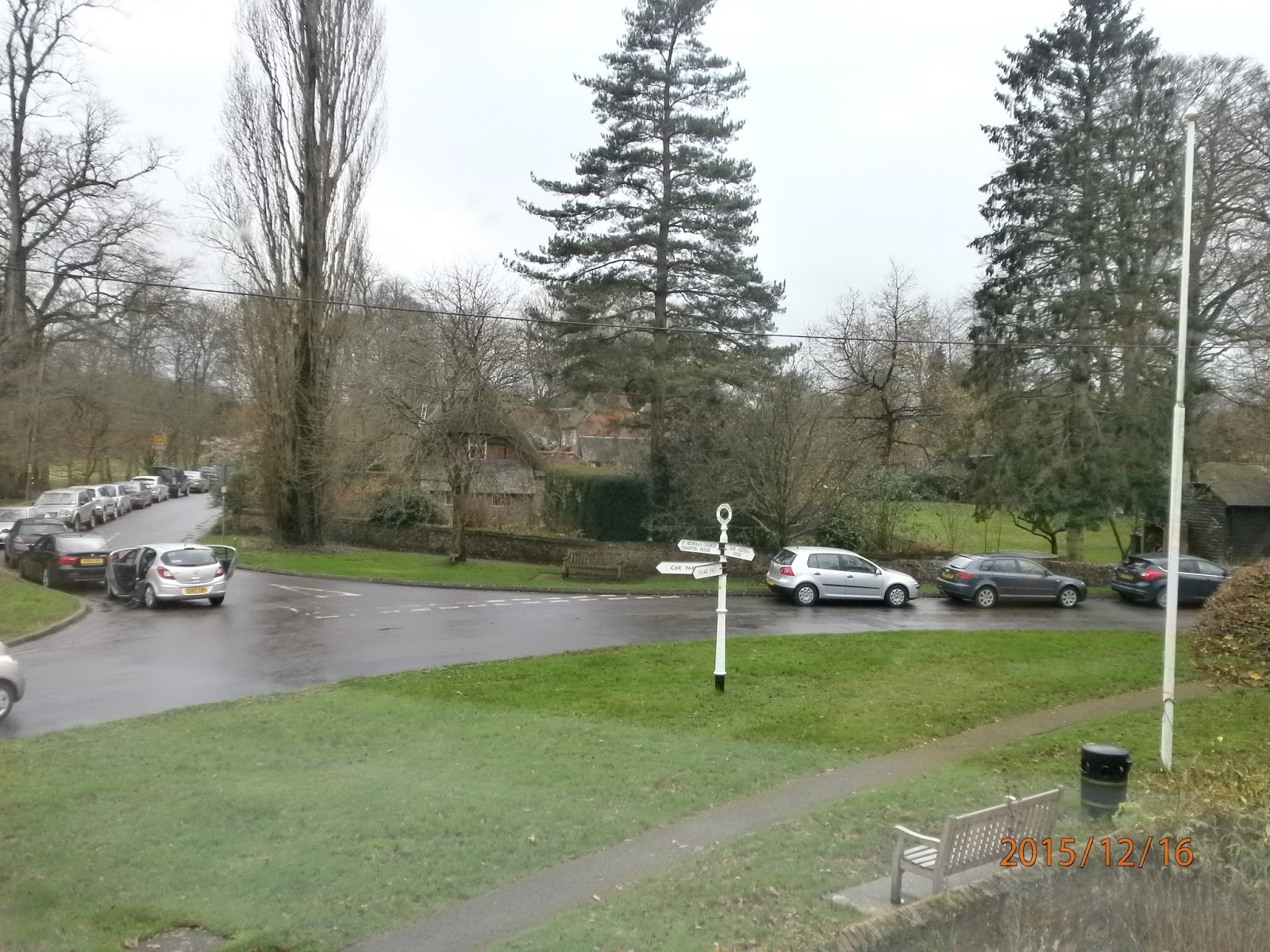
Although the weather was nothing to write home about, the cottage was packed with visitors, as you can see from the number of cars parked outside the cottage – there were obviously many of us wishing to spend this special day at Chawton. This was the view from one of the windows in the cottage, showing the busy thoroughway that Chawton was in the days of Jane Austen.


It was lovely to sip some tea and enjoy some mince pies, while strolling about the cottage garden. There was also some carol singing by the Regency piano, making it all very festive and atmospheric.


No pilgrimage to Chawton is complete without a look at (and touch of) Jane Austen’s modest, yet iconic writing desk.


And a look out of the dining room window, as famously was important for Mrs Austen to have a good view of the goings-on in the street.


My two-year-old travel companion had fun trying on some bonnets, and then we headed towards Chawton House Library. Although the views were less picturesque in this weather, come rain or sun, I love the walk towards Chawton House past some beautiful rolling hills and green fields dotted with sheep.


I have always wanted to see the interiors of Chawton House, as this was the great house of the estate owned by Jane Austen’s brother, Edward Austen-Knight, and Jane Austen spent a great deal of time with her family there.


Chawton House looked very inviting, with beautiful lighting in the windows,  but I was disappointed to find, once again, that the House was closed until March… however, that can only mean one thing  - another visit to Chawton in a few months’ time, something to look forward to!