Search this Blog

Saturday, June 18, 2016

Following the footsteps of the Austen brothers in Portsmouth

Over the Easter holidays I travelled to Portsmouth with my family to visit the naval dockyard and in particular, the old battleships, HMS Victory and HMS Warrior. Jane Austen's brothers, Frank and Charles, were sailors, working on similar ships, as were several of Jane Austen's characters, most notably Captain Wentworth (Persuasion) and Fanny Price's brother William (Mansfield Park). 


Through her brothers, Jane Austen herself was very familiar with naval life and took a keen interest in her brothers' work, and it therefore comes as no surprise that she has used the setting so extensively in her novels. She held an admiration for the navy, and Frederick Wentworth is inarguably one of her most attractive, masculine characters. It was fascinating to get a glimpse into the world of the navy of her time and get a close viewpoint of how life was onboard and on the docks.

HMS Victory.


HMS Victory is, of course, one of the most famous battleships of Jane Austen's time, used by Nelson in the Battle of Trafalgar, the decisive sea battle against the French in which the famous admiral was shot and killed in 1805. Nelson was hugely admired and praised at the time, and Frank Austen was excited to serve under his command. Frank was upset to have missed the Trafalgar action, as he had only just been commanded elsewhere, and he never quite ceased to be disappointed. No doubt, HMS Victory must have been very similar to the boats on which Frank served.


HMS Victory is beautifully built and well maintained. The low ceiling and slanted floors of the captain's quarters, or "The Great Cabin", give an antique feel to it, in comparison to the newer Warrior. 


The living conditions were certainly better for the captain and his commanders than the sailors down below. 


The conditions on the Lower Gun Deck below were very cramped. It is dark, the ceilings are lower, and as you can see, it is difficult to get a good photo in the dim conditions. There was just a tiny hammock space allotted to each sailor, with cannons between the cots.There were 450-600 sailors dining and sleeping on the deck at the same time, and the arrangement hardly allowed any privacy. 


The food prepared in the Galley was basic but high in calories, mainly consisting of boiled beef or pork with vegetables or dried fish. Animals were kept on board for meat. The meat was salted down in casks to preserve it.


While HMS Warrior is a newer ship, built in the 1860's, seeing the interiors of the ship would give you quite a good idea of life on board. The captain and the commander's quarters were quite livable, although they were not very large. Naval life must have been very ascetic indeed back at the turn of the century, when the facilities on board were so much more basic.

Life on board was no plain sailing (excuse the pun!). Sailors often suffered from seasickness, Nelson himself included. "Decks could be like wet porous stone with dampness below in every hammock. The hacking cough of men echoed in every hour of the watch. More men died of tuberculosis than were killed by shot, and other diseases...were common" (Honan, p, 160-1.)

However, you couldn't afford to be lazy; there were brutal punishments for inefficient sailors and even the young officers in training. Flogging was commonplace. "You faced the grating with tied wrists as bosun's mates flogged your back into livery pulp. Twenty lashes for minor naval infringements were common: fifty exposed your bones. When three sailors were sentenced to 400, 500 and 600 lashes in this harbour, mates flogged at upright corpses" (Honan: p. 2).

Bloodshed was obviously part of the business, and on the Orlop Deck where wounded sailors were taken for medical assistance, there were some gruesome details on display, such as an amputated leg and some bloody instruments.


Having seen the ships, you realise that running a large ship like this must have been a mammoth task. It took hundreds of men just to lift the anchor, let alone run the machinery. It would also take a very efficient and powerful captain to run a ship and make it successful. As I was listening to the guides' stories about the ships, it made me realise just how powerful a person a naval captain would be. He would be in charge of literally hundreds of sailors and could basically do just as he pleased. He was an authoritarian head who would decide the fates of all these men and their families.


Walking down the decks, I imagined myself an Anne Elliot on board with her Captain Wentworth. Seeing the ships helped me understand the story behind Persuasion better. Being a captain was certainly a glamorous job at the time, and one could understand why Anne "gloried in being a sailor's wife". With his newly acquired prize money and fancy title, Captain Wentworth would be a thousand times more presentable in society, a powerful figure and a military hero that people would look up to - Anne Elliot not the least.

However, as I recall Mrs Croft's stories in Persuasion about life on board, describing how wonderful it was to accompany her husband, Admiral Croft, on board, it is hard to imagine anything glamorous about naval life. There was a lot of hardship in terms of food, health and general comfort, and to be one of the only ladies surrounded by hundreds of men through episodes of bloodshed, drunkenness and foul language, it baffles me how the accompanying wives coped from day to day. It reminds me of the scene in Persuasion where Captain Wentworth argues with his sister, Mrs Croft, claiming that a battleship is no place for a woman: "I hate to hear of women on board, or to see them on board; and no ship, under my command, shall ever convey a family of ladies any where, if I can help it." (Ch. 8)

Yet, this was the life that Jane Austen knew inside out and romanticised about; as described by her nephew, James-Edward Austen Leigh, "with ships and sailors she felt herself at home" (p. 18).


References: 

'Austen-Leigh, J. E. (2002) A Memoir of Jane Austen and Other Family Recollections. Oxford World Classics.

Honan, P. (1987) Jane Austen - Her Life. Phoenix Giant. 

Sunday, May 29, 2016

Review of Love and Friendship

Love and Friendship, the film adaptation based on Jane Austen's novella, Lady Susan, was released in the UK this week.

 Unfortunately, the film is only showing in a handful of cinemas and for a very short period of time, which urged me to travel a long distance to catch a rare viewing of this long-awaited adaptation. 


As I mentioned in my earlier post, the film was directed and produced by Whit Stillman, the producer of Metropolitan (a modern remake of Mansfield Park). Having enjoyed Metropolitan, I had fairly high expectations for Love and Friendship, and I couldn't wait to see how Whit Stillman had managed to adapt the Georgian style epistolary novella onto big screen. 

Stillman's biggest challenge must have been the screenplay - how to to transfer the story, entirely written in letters, into well-flowing dialogue and narrative. I was pleased to see that the film has stayed faithful to the original story and very much responded to my own imagination of the characters, the setting and so on. The worst thing is to see a favourite novel changed dramatically when adapted onto screen, but this wasn't the case with Love and Friendship. 

The film correctly portrays Lady Susan (played by Kate Beckinsale), a widower, to be an attractive, charming and intelligent lady, whom we later discover to be a manipulative, selfish person with a lack of empathy for others - this is particularly shown in her interactions with her friend and confidante, Mrs Johnson (Chloe Sevigny). Overall, the film is very well cast, Beckinsale making a credible Lady Susan, perhaps thanks to the fact that she has previously played another less likeable Jane Austen character, Emma (1996), and is clearly quite comfortable with the lengthy, archaic dialogue. Lady Susan's young suitor, Reginald DeCourcy (Xavier Samuel), his parents (James Fleet and Jemma Redgrave) and Lady Susan's suppressed daughter, Frederica (Morfydd Clark), all corresponded to the characters I had created in my mind while reading the novella. 

While there is very little scenery in the film, I enjoyed the period-style string music playing in the background, the beautiful Georgian interiors and exteriors and the shiny, silky costumes (which actually create a brushing sound as the actresses move around the room), not to mention the high Georgian hairdos with flowing curls. However, I thought that some of the male characters, perhaps, looked a little too modern, and should have had long hair tied up in a pig tail, like the Austen brothers did at the time. 

At the beginning, the characters are introduced posing and what Stillman calls "arch intertitles". There are several characters in the novel and this was probably done to make it easier for the viewers to follow the plot. I would have preferred it if the characters had been presented in a more "natural" way, as they were presented in Pride and Prejudice - a servant announcing their names, as they entered the room, for example. I also thought that the beginning of the film could have been a little more dynamic - I was actually looking forward to a more dramatic entrance of the main character, Lady Susan.

While the beginning is a little stiff in parts and had me yawning a few times (very unlike me during an Austen film!), the film does improve towards the end. The film clearly caters to a more learned, connoisseur audience rather than the general masses - being an independent film-maker, perhaps Stillman has not aimed at a wider distribution of the film, allowing him to take some interesting creative liberties. However, I would like to see the story popularised to make it known to the wider world, but this would require some simplification of the story, more dynamic changes of scene and some more theatrical characterisation. There are a few deja-vu characters typical of the Jane Austen adaptation, such as Frederica's suitor, Sir James Martin (Tom Bennett), who borders on the ridiculous in the style of Mr Collins (Pride and Prejudice), and the theatrical Mrs Manwaring (Jenn Murray). 

While the adaptation stays very faithful to the original, there are some very interesting twists to the story at the end, including an adulterous Lady Susan, clearly added in for entertainment value. I will not narrate the story or reveal the final twists at the moment as I don't want this review to be a spoiler. The film is very much centred around the brilliant dialogue and I would certainly recommend seeing it if you enjoy all of Jane Austen's works and yearn to see more. 


Tuesday, May 3, 2016

"They had a very fine day for Box Hill"


"They had a very fine day for Box Hill", wrote Jane Austen in the seventh chapter of Emma. While many of Jane Austen's locations are imaginary, this important, dramatic scene takes place at a location that still exists with the name of "Box Hill". 

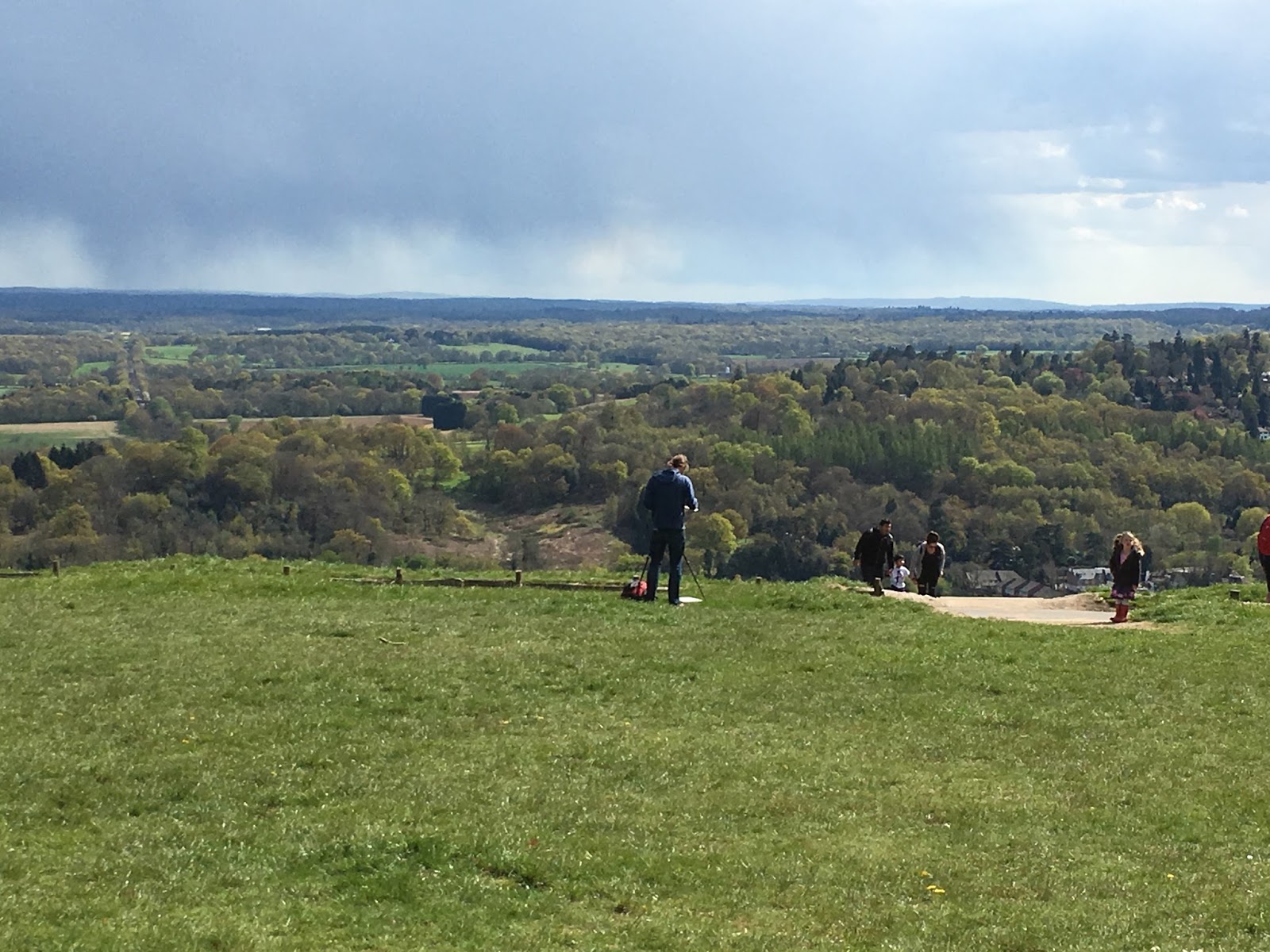
As we had a very fine day, we decided to drive to Box Hill with my family. I have been wanting to visit Box Hill for a long time, and was really pleased to visit the famous picnic spot on such a lovely, sunny day. 

Box Hill is situated between Leatherhead and Dorking amidst some of the most beautiful countryside of Surrey - called "an Area of Outstanding Natural Beauty". 

It is easy to imagine horse carriages along these the old, narrow zig zag roads that lead up to top the hill. 


The views from the top of the hill are phenomenal and present a gorgeous panorama over the beautiful Surrey countryside. No wonder the place is still popular with picnickers - a lovely place to admire the views or to paint a landscape (as below).


Picnics have been popular ever since the beginning of the 19th Century, although they must be a great deal simpler to organise these days. In Jane Austen's days, it must have demanded a great deal of labour, cooks and servants, to deliver a wholesome picnic. These days, Box Hill is a popular tourist site owned by the National Trust with walking tours and family trails amongst other activities. 


Jane Austen was obviously familiar with Surrey, frequently travelling through the county to London to visit her brother, Henry, in London and Edward in Kent. On the way, she sometimes called on her mother's cousin, Cassandra's family in Great Bookham. Cassandra had married the Reverend Samuel Cooke, who was rector of Great Bookham from 1769 to 1820. He was Jane's godfather and the Austens were close to the family.

Interestingly, Jane visited Great Bookham in June, 1814, the year when she had started writing Emma. During this visit, she might have got inspired to set one of the most important scenes of her novel on Box Hill. Perhaps, like Emma, she visited Box Hill and was "in tranquil observation of the beautiful views beneath her". While I am partial to Hampshire (for obvious reasons), I must say that I have fallen a little in love with the Surrey countryside as well. 

Of course, the midsummer picnic starts with a "very fine day, and all the outward circumstances...were in favour of a pleasant party", but as we know, the party ends in a disaster, with Emma not the least to blame. The Box Hill episode shows her the strength of her power over others and humbles her down. Badly done Emma.


References and further reading: 

Chapters 6-7 in Jane Austen's Emma.

Edwards, A-M. (1991) In the Steps of Jane Austen - Walking Tours of Austen's England. Wisconsin: Jones Books. 

Picnicking on Box Hill in Jane Austen's World 

Box Hill in Jane Austen's Emma in Jane Austen in Vermont 


Friday, April 15, 2016

The Highlights of "Emma 200: From English Village to Global Appeal" at Chawton House Library

A few weeks ago, I visited Chawton House Library to view the fascinating exhibition, "Emma 200: From English Village to Global Appeal", that commemorates the 200th anniversary of the publication of Jane Austen's Emma. Emma 200 is the first major exhibition held by the library and a must-visit for any admirer of Jane Austen's literature. 

As I had my little children with me, I was only able to have a brief glimpse of the exhibits, but I would certainly love to go back and peruse the items in more detail. In this post, I will share some of the things that captured my attention, along with some (very poor) images taken by my mobile camera.  I do apologise for the picture quality, but feel I should share some images rather than upload a blank post. For a more detailed review of the exhibition, you could have a look at the Review by the British Society for Eighteenth Century Studies.

As you enter the exhibition, the first things on display were a first edition of Emma, alongside a French and an American edition from 1816. Wouldn't I just love to get hold of one of these and have an original experience of reading Emma. I can just imagine how fragile these books must be when you are browsing through them.


The exhibition also features a number of newer editions of Emma - an interesting collection of adaptations of Emma from popular culture. Now these are editions that I am far more familiar with, as you would find several of these in my bookshelf! Most recently, I have read Alexander McCall Smith's modern re-telling of Emma (top row, second on the left), and have enjoyed watching all the film adaptations and their companions, too.


One of the highlights of the exhibition for me would have to be Maria Edgeworth's silver inkstand and letter.


Edgeworth was one of the most popular women authors of her time and one of Jane Austen's favourite writers, a real source of inspiration for her from early on. In 1816, Jane Austen sent a presentation copy of her novel before its publication to Edgeworth, but unfortunately, the recipient wasn't impressed by it. The letter below, written by Edgeworth, reads 

"There is no story in it, except that Miss Emma found that the man whom she designed for Harriet's lover was an admirer of her own—& he was affronted at being refused by Emma & Harriet wore the willow—and smooth, thin water-gruel is according to Emma's father's opinion a very good thing & it is very difficult to make a cook understand what you mean by smooth, thin water-gruel."
 
Edgeworth did not even acknowledge or thank Jane Austen for the copy of her book.


In this more famous letter, from Charlotte Bronte to her publisher's literary advisor, Williams, in 1850,  Bronte criticises Jane Austen in the following way:

"I have likewise read one of Miss Austen’s works, “Emma”- read it with interest and just the degree of admiration which Mis Austen herself would ache thought sensible and suitable- anything like warmth or enthusiasm; anything energetic, poignant, heart-felt is utterly out of place in commending these works: all such demonstration the authoress would ache met with a well-bred sneer, would have clammy scorned as outré and extravagant. She does her business of delineating  peole seriously well; there is a Chinese fidelity , a miniature delicacy in the painting: she ruffles her reader by nothing vehement, disturbs him by nothing profound: the Passions are perfectly unknown to her; she rejects even a speaking acquaintance with that stormy Sisterhood; even to the Feelings she vouchsafes no more than an occasionally graceful but distant recognition; too frequent converse with them would ruffle the smooth elegance of her progress. Her business is not half so much with the human heart as with the human eyes, mouth, hands and feet; what sees keenly, speaks aptly, moves flexibly, it suits her to study, but what throbs fast and full, though hidden, what the blood rushes through, what is the unseen seat of Life and the sentient target of Death- this Miss Austen ignores; she no more, with her mind’s eye, beholds the heart of her race than each man, with bodily vision sees the heart in his heaving breast. Jane Austen was a complete and most sensible lady, but a very incomplete, and rather insensible ( not senseless) woman; if this is heresy- I cannot help it.If I said it to some people(Lewes form instance) they would directly accuse me of advocating exaggerated heroics,but I not afraid of you falling into any such vulgar error."

Jane Austen was keen to collect opinions on her books, and religiously noted them down in her notebook. Thankfully, Jane Austen was blissfully unaware of these criticisms. 

Sir Walter Scott's review of Emma (below) in The Quarterly Review was more favourable. In his opinion, Jane Austen was an original writer, and Emma represented an entirely new, realistic style of fiction that he admired.


The exhibition also features a copy of the Lady's Magazine, a hugely popular magazine from 1811, which catered to ladies of the gentry. Jane Austen is pretty sure to have read the periodical and I would love to have a browse through it. We will learn more about the magazine through this fascinating research project undertaken by the University of Kent.


The magazine was important for female authors like Jane Austen, as periodicals were the main channel through which ladies could publish their essays and stories and gain publicity in the literary circles. This would, in turn, enhance their chances of getting published by the likes of John Murray (whose correspondence is also displayed at the exhibition).

The Ladies' Magazine also featured topics relevant to women at the time, such as fashion, poetry and needlework, and featured patterns for embroidery. 10 of these patterns were recreated in an international stitch-off project and the results are on display in the Oak Room. The designs are beautiful and intricate and reminded me of the embroidery (possibly made by Jane Austen) on her tiny glasses case on display in Basingstoke.


What a fascinating exhibition! I would definitely urge any admirers of Jane Austen's literature to visit the exhibition and get an interesting glimpse into the literary life of the early 19th Century. 

Saturday, April 9, 2016

Finally at Chawton House!


Whenever I visit Chawton Cottage, I feel like I have stepped back in time for a day. It felt exactly like that when I visited Chawton House Library or, "Chawton Great House", as it used to be called. I believe that the house still looks very much as it did in Jane Austen's times, although it is an even older building, dating back to the Elizabethan times. 

 
I have tried visiting Chawton House a few times before, but never managed to be there at the right time. I was so pleased to gain entry and to have a thorough look through the house. I was able to take some photos of the house, but I do apologise for the quality of the photos, as I only had my mobile phone camera on me. 

The manor was owned by Jane Austen's brother, Edward Austen-Knight, who lent it out to gentlemen tenants but also spent a great deal of time here himself . He divided his time between his two estates, Godmersham in Kent and Chawton, and thanks to his position as a wealthy landowner in Chawton he was able to provide a home for his mother and sisters in Chawton. Jane Austen was obviously very familiar with Chawton House and visited there regularly for dinners. 


These days, the manor serves as the Centre for the Study of Early Women's Writing from 1600 to 1830. The centre houses a vast collection of early women's writing, open to the benefit of scholars from across the world. There was an exhibition on, called Emma 200, dedicated to the 200 years since the publication of Jane Austen's Emma. It was a fascinating exhibition and I had a brief look through - I will share some photos soon. 


The house was built in 1580 by John Knight, an ancestor of Thomas Knight (picture below), who adopted Edward Austen and made him his heir. 


  Jane Knight, wife of Thomas Knight.
                                   
 These coats of arms show all the proprieters of the estate - the Knights.


Interestingly, Edward's coat of arms has a small red square at the top left, indicating that he was not a real "Knight" but was given the name through his adoption, and all his descendants have the same symbol in their coats of arms, too. 


As you enter the house, you come through to the Great Hall on your left. It is an impressive room and has retained its original Elizabethan wooden panelling. 


Dark panelled hallways take you from one room to another. 


In this dining room, you can imagine Jane Austen enjoying lengthy dinners with her family whenever Edward was in Chawton.


In the dining room, there is a portrait of Edward Austen-Knight, made during his Grand Tour of Europe. 


There is also a touching memento, a well-preserved jacket on display, which used to belong to Edward Austen when he was a young boy. It is easy to believe that the jacket belonged to him, as the jacket is very similar in style to the one in the portrait, with a similar cut and equally large buttons.


There were also several other familiar images of the family members on the walls, including that of Elizabeth Austen, Edward's wife (sorry about the poor picture quality). 


This is an image of Edward Austen Knight's Godmersham estate. 


The view from the dining room window. 


As you go upstairs, there are some beautiful heavy tapestries and some original William Morris wallpaper that was discovered during the restoration of the building in the nineties. 


I loved the Library, an intriguing place where you could imagine the gentlemen sitting down, writing letters and having a drink. 


The library is full of good novels and even a secret cupboard, perhaps used as a bar?


There are some beautiful windowsills upstairs that call out for a little rest and a look at the lovely views of the surrounding countryside. 


This old printing press is fascinating. It takes a relatively small machine to produce tons of books. 


During his time in Chawton, Edward Austen had a servants' passage built downstairs for privacy and safety. 


The passage takes you to the old kitchen, which has retained its old stone flooring and an 18th century worktable, although the range was acquired in the Victorian times. 


Behind the kitchen, there is a scullery, which now houses a bookshop. There are two original sinks in the room, which would supply water from a nearby well.


Here is a view out to the inner courtyard...


...and out to the garden. 


There is a Regency walled garden, designed in the style adopted by Edward Austen after the death of Jane Austen. However, I did not have the time to have a closer look at the gardens - something has to be left for next time! I enjoyed the views over the beautiful Hampshire countryside that surrounds the Great House.