Search this Blog

Showing posts with label Movies. Show all posts

Thursday, July 21, 2022

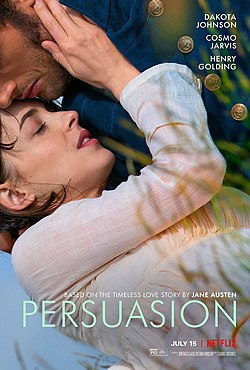
Persuasion 2022 - Jane Austen for the Instagram Generation


I thought I should jump in the bandwagon and mention my thoughts on the new Persuasion film on Netflix, starring Dakota Johnson as Anne Elliott. Having seen some screenshots, I didn't have high hopes for the film, but I decided to watch it through with an open mind and find both positives and negatives about the film. I always seem to revert back to the 1990s adaptations on Austen novels, preferring a more traditional true-to-the-book approach and struggled with the positive list to be honest, but I have made an effort! 

Here is a list of my 10 positive and 10 negative thoughts about the film: 

Pros:

1) The cinematography is beautiful - the vivid colours, lighting, angles and handheld camera shots which make some scenes seem realistic. 

2) The landscapes are lovely, especially the dramatic seaside shots in Lyme regis that remind me of Sanditon. 

3) There are several nature scenes with quaint countryside shots, which I enjoyed. 

4)  The sets are gorgeous, with a lovely range of colourful decor and stunning wallpapers and furnishings. 

5) Most of the costumes are wonderful and several look authentic - with the exception of Anne Elliott's strange wardrobe and the lack of bonnets. 

6) I enjoyed the lively scenes where Anne plays with her little nephews and nieces. I imagine Jane Austen herself would have messed around like this with children! 

7) The plot follows Jane Austen's Persuasion quite closely (although some significant scenes and characters have been omitted/changed as below). 

8) Most of the acting is decent, and I particularly enjoyed the grumpy Mary Musgrove (Mia McKenna) and the charming William Elliott (Henry Golding). (I was disappointed with Richard E Grant's Sir Walter, however, as I was looking forward to an amazing performance by him). 

9) The film is entertaining and easy for a Jane Austen novice to follow. 

10)  Persuasion 2022 introduces Jane Austen to younger generations in a fun way so that youngsters can relate to the characters - think Instagram, TikTok, Fleabag. 

The cons (which do not end here): 

1) The overall feel of Persuasion changes here - the original feel of the book is somewhat sad, autumnal, reflecting on lost opportunities. 

2) In the book, Anne is described as past her bloom, plain and melancholy and only brightens up later in the book as she begins to realise that Captain Wentworth loves her after all. Dakota Johnson's Anne, on the other hand, is gorgeous, confident, fun-loving, sarcastic and an upbeat character - even ridiculous in places, as opposed to the sensible, mature Anne of the book. 

3) The film is oblivious of formal Regency manners and etiquette, which the upper class characters would certainly have abided by. 

4) The dialogue is not taken from the original and I miss Jane Austen's beautiful language and classic quotations in this - the language here is far too modern, with phrases such as 'in-laws', 'narcissist', 'electrifying', 'playlist', 'cappuccino', 'fart around' and 'out of my league' casually thrown in. The accents don't sound right either... 

5) Anne's strange costumes, modern makeup and hair are so out of place and distract from the rest of the characters, who are much more appropriately dressed. 

6) I did not enjoy the monologues, which I only tend to appreciate in Lovejoy - but each to their own in this case. 

7) Captain Wentworth lacks charisma. He is supposed to be the head of a ship and of dozens, perhaps hundreds, of sailors, and would have to have had a strong presence to get to that position. Cosmo Jarvis' Wentworth looks dreamy and lethargic, as opposed to Ciaran Hinds' perfect rendition of the confident, charismatic captain who Anne looks up to. 

8) Period lifestyle details have been overlooked, such as in the swimming scene. Ladies of the gentry would access the water through a swimming machine to protect their modesty, as seen in Sanditon. 

9) Don't get me started on the rabbits, octopuses, 'wild wees' and Anne's drunkenness in this film!

10) Last, but not least, the plot moves too fast and a scene has been added in the middle of the film where Wentworth and Anne discuss their true feelings on the beach. Highly disappointing, as the story ought to be a slow burn, culminating in the intense letter scene at the end of the novel. 

In conclusion, if you watch Persuasion 2022 with the same mindset that you would have while watching Bridgerton, looking for easy entertainment, you might just enjoy it. The film certainly has its cringeworthy moments, but it is a quirky, modern take on a classic for the Instagram generation. 

Sunday, March 8, 2020

On Location in Lacock

Last Mother's Day (wow, it has taken me a year to write this post!) I was taken to Lacock in Wiltshire for a treat. I am a big fan of the National Trust, and I had wanted to visit Lacock for a long time, as it is one of the most famous film locations for several period dramas - most interestingly, the location for Meryton in Pride and Prejudice (1995) and Highbury in my favourite adaptation of Emma (1996 with Kate Beckinsale) - not to forget Downton Abbey. 


Stepping into Lacock is like stepping back in time. Lacock Abbey dates back to 1232, and the village houses are several centuries old. You can easily imagine why production companies might choose this as a location, as the village has changed very little over the centuries, there is not a satellite dish in sight (those are banned by the National Trust), and the only thing to remind us of our modern times is the cars parked on the side of the road. 


Lacock is, however, a working village with a school, village hall, church, quaint boutiques and several pubs, but walking the roads truly feels like walking through a film set. 


The High Street was used as a location for the Meryton high street. The exterior of the Red Lion pub on your left was used as a location for Meryton Assembly Rooms in P & P where Sir Lucas' country ball was held. Don't you love all those vintage cars parked outside? 


The High Street was also seen as shops in Pride and Prejudice, such as the haberdasher's shop where the Bennet sisters stopped to look at bonnets until they were interrupted by Mr Wickham (and a cold greeting from Mr Darcy). 


Another street, Church Street, served as the high street of Highbury in Emma. 


St Cyriac's Church was where the Westons'  wedding was shot at the beginning of Emma and perhaps some of the other wedding scenes as well (who recognises the church?)


I enjoyed reading "The Making of Jane Austen's Emma", which was a companion for the 1996 film. In the book, there are interesting stories about the production in Lacock. We learn that the company had just three days to film the Lacock scenes, as it was a busy time in the village and the National Trust didn't wish to have filming during the weekends, which are their busiest time with tourists flocking the village. 


It was fascinating to read about how the village was transformed from 1996 to 1813. Ground cover was laid, earth and grit spread around the roads, autumn leaves and manure scattered around the floor, straw for horses left in places... 


Some of the facades, for example Miss Bates' house, were changed entirely, and signs were changed to period ones, film lights added in front of windows and cars moved from the roads. Even the existing flowers were swapped with more period-appropriate ones. 


Some of you might recognise this house as being Harry Potter's first home. 


Harry Potter's Hogwart's school was shot in Lacock Abbey cloisters. This was also used as a location for Cambridge University, where Mr Darcy studied as a young man with Mr Wickham. We visited Lacock Abbey as well, which is an interesting building in itself, but the cloisters were closed at the time as there was a film crew working on a series. 

There are stalls and shops selling various Harry Potter related paraphernalia around the village, catering to the flocks of tourists that visit the village. I loved it how there were many stalls (as below) in front of people's houses, selling crafts and preserves with an honesty box and not a salesman in sight. Obviously, being a National Trust village, there is a feeling of trust that people will behave sensibly and be kind to the locals. 


All in all, Lacock is a wonderful place to visit and I would recommend a day trip there with a visit to the Abbey, one of the lovely ancient pubs, and the quaint gift shops that line the streets of Lacock, spotting familiar film locations on the way. 

You can get more information on Lacock and several other film locations in Karin Quint's guidebook and do have a look at the film companions for some interesting snippets. 

Further reading: 

Birtwistle, S. & Conklin, S. (1996) The Making of Jane Austen's Emma. Penguin Books. 
Birtwistle, S. & Conklin, S. (1995) The Making of Pride and Prejudice. Penguin Books. 
Quint, Karin. (2019 Jane Austen's England - A Travel Guide. ACC Art Books. 


Thursday, February 20, 2020

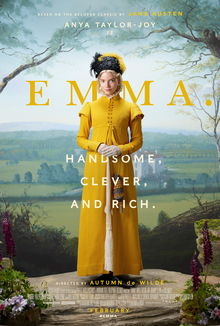
My Thoughts on Emma (2020): Not "badly done"!

Emma poster.jpeg


I thought I should voice an opinion on the newest adaption of Emma (2020), which came out last week. I was really excited to see the film, but equally daunted by the possibility of the film proving to be an utter disappointment like Sanditon, which I never bothered to review after the first episode, which ended any similarity to Jane Austen. Fortunately, I was pleasantly surprised, although it is hard for me not to compare it to my favourite version of Emma (1996 with Kate Beckinsale).

Emma (2020) was directed by (the beautifully named) Autumn de Wilde, this being her directorial debut (she is better known for music videos and portraiture), and written by novelist Eleanor Catton. De Wilde's Emma is an entertaining and gorgeous take on the novel, with lavish pastel coloured sets and hilarious performances by well-known, popular actors, such as Bill Nighy and Miranda Hart. Last year, Andrew Davies mostly left out the comedy in Sanditon, so essential to Jane Austen's style of writing, but de Wilde's Emma has comedy in abundance, sure to entertain a wider general audience. 

I was delighted *finally* to see costumes so true to the period, with light muslins, sheer fabrics and lots of white (indeed, "a woman can never be too fine while she is all in white" -  Edmund Bertram -Mansfield Park). No hair flowing down the shoulders (à la the hideous Billie Piper in Emma and Charlotte in Sanditon). No strangely low waistlines (à la Pride and Prejudice 2005), no modern looking fabrics (several adaptations). Curator's Curio has written a great comprehensive analysis of the costume in this film. The sets, albeit beautiful, do seem a tad too elaborate, with numerous high towers of cakes, excessive floral arrangements etc. The beautiful sets probably reflect de Wilde's artistic background and her sense of the aesthetic, but are perhaps a little too "art for art's sake" to be realistic. 

Now to Emma, our feisty, independent "heroine whom no one but myself will much like" (Jane Austen). I feel that the film beautifully captures the spirit of Emma, Anya Taylor-Joy portraying her well; it helps that she is almost the same age and has Emma's captivating hazel eyes, which first haunted me in the period piece, "The Miniaturist". 

The chemistry between her and Mr Knightley (Johnny Flynn) is strong, and Johnny Flynn does the role beautifully (as he did in Vanity Fair). However, I would have to agree with many others in that (while Flynn, at 36, is almost the same age as Mr Knightley, 37) he does look too young to be Mr Knightley. I find that the age gap between Emma and Mr Knightley is one of the central themes in the book; after all, he is like the older brother for Emma, being 16 years older than her; being an older family friend, he feels moral responsibility over Emma. The age gap, which is therefore of some significance, does not really show in this film - unlike in 1996, where Mark Strong made a much more credible Knightley.  

I enjoyed watching Josh O'Connor (who I thought was brilliant in the Durrells) as a hilarious, off-putting Mr Elton, and Miranda Hart as the annoying spinster, Miss Bates, although (me being finicky) I didn't imagine her to be as tall as the stately Miranda Hart! Bill Nighy makes a great hypochondriac Mr Woodhouse; however, I could have done without his usual snorting. 

The dialogue does not appear to follow the book word to word, but the script does stay faithful to the original plot for the most part and, to my relief, the style of speech and manners appear contemporary to Jane Austen (unlike in Sanditon, which took many liberties to suit a more modern audience). The intriguing word game scene at Box Hill has been left out, and there are a couple of scenes at the end, which differ from the original: 1) when Emma goes to the Martins' farm and apologises to Mr Martin, and 2) a (horrendous) proposal scene (with bodily fluids involved, no spoilers however!). I would have liked to have seen a more romantic proposal faithful to the style of Jane Austen. 

Also, there seems to be a general trend these days to add nudity in Jane Austen wherever possible, and this film makes no exception. The very first scene where we meet Mr Knightley, we get a view of him stark naked from behind and, while I am no prude, I thought it was unnecessary. Fortunately, de Wilde does not venture further with the nudity and we do not see Emma catching a glimpse of a naked Mr Knightley, which would have suited Andrew Davies very well.  

Overall, I felt that Emma has been skilfully made and has clearly been created with a wider audience in mind, with some great comedy elements and an impeccable style. I would love to see it once again to get a better feel of the film and to enjoy those costumes once more.  


Friday, February 22, 2019

Winter Visit to Basildon Park (Netherfield)


Yesterday I visited Basildon Park, a large, beautiful Georgian country house owned by the National Trust and situated in the Thames Valley in Berkshire, down the road from Reading. I had been hoping to visit the place for quite some time, as the mansion is famous for serving as a filming location for several period dramas, such as Downton Abbey, the Duchess, and Pride and Prejudice (2005). 


Admittedly, I am no fan of the 2005 version of Pride and Prejudice, as I am only too conscious of the historical inaccuracies in this adaptation of one of my favourite novels. However, I do admit that many of the locations in the film are gorgeous and, cinematographically, the film does have some beautiful scenes in it. 


In the film, Basildon Park is the location of Netherfield, Mr Bingley's home. The two main scenes filmed there include the Netherfield Ball (filmed in the dining room) and Lizzy's visit to Netherfield (filmed in the Octagon Room). The Dining Room (below) was also used as a location for the Downton Abbey London home. 


A volunteer, who was there during the shooting of Pride and Prejudice, interestingly told me that the filming day was an extremely hot summer's day. There were up to 200 people in the Dining Room at any one time with the dancers, the orchestra, and the filming crew all packed in these sweaty conditions. The number of people seems very large, as the room is not as spacious at it appears on film, with a large mirror mounted on the back wall creating an illusion of extra space. In addition, there were decorated boards covering the original design of the walls, making the room even smaller! The furniture was obviously moved from the room, as was the 200-year-old carpet, for the duration of the dancing. 

The allegedly 200-year-old carpet that was rolled up and stored in the attic for the duration of the filming.

The Octagon Room (below) was the scene of some prickly repartee, where Mr Darcy and Mr Bingley admire the ladies and pass some comments while  Lizzy takes a turn about the room with Miss Bingley. Here, too, the original crimson-coloured walls walls were covered with pastel-coloured board, changing the entire look of the room. 


The mansion itself dates back to the 18th Century (Georgian era) and was commissioned by Francis Sykes in 1771. Having made a fortune in the East India Company, Sykes was looking for a home befitting his status, and Basildon Park just served the purpose. For this reason, there is a room dedicated to India downstairs (below), beautifully decorated with elaborate landscape wallpaper. The room displays Indian items of clothing and stories written by people about their memories from India. I almost felt like writing a memoir of my own and adding it in! Or perhaps I could have added the bit about Jane Austen and her Colonial Connections...

A kurta and a sari and pictures of Indian nawabs with exotic wallpaper. 


Some of the original Georgian features were still there, such as this beautiful ceiling decorated with plasterwork. 


We also had a look at the bedrooms, some of which still had a period design. 


This regal-looking four-poster bed dates back to the 1820s. 

This one was more modern, with textiles designed by the the last resident of the house, Lady Ilyffe. 


The drawing room displayed some impressive paintings from the family collection. 


I thoroughly enjoyed my visit to Basildon Park and its beautiful parkland, with glimpses of the Thames flowing right below (almost visible in the picture below)... 


Saturday, December 17, 2016

Regency Christmas at Mompesson House

Happy Birthday, Jane Austen! Last year I celebrated this day at Jane Austen's House in Chawton, and what a memorable, beautiful day that was, singing carols and enjoying some mulled wine and mince pies at Chawton, perusing the Emma exhibition and trying on bonnets with my two-year-old dress-up enthusiast. 

This year, I didn't make it to Chawton Cottage but I did visit Mompesson House in Salisbury for their Regency Christmas display at the weekend. 


Mompesson House is a Georgian house situated in the Cathedral Close in Salisbury. You may have seen the house in the beautiful 1995 adaptation of Sense and Sensibility where the house was used as a location for Mrs Jennings' Chelsea home. Both the exterior and the entrance hall were used in the film.


In the film, Mrs Jennings walks the staircase with authority, greeting her parrot on the way. Elinor climbs the staircase with Lucy Steele, discussing Marianne's rumoured wedding. 


The drawing room upstairs was also used in the film, but the upstairs rooms were closed for visitors. However, I enjoyed the display downstairs and remember seeing a similar exhibition at Fairfax House in York years ago.

The downstairs rooms of Mompesson House were decorated with greenery, ribbons, fruit and candles in the fashion of the late 18th and early 19th century. Fireplaces, shelves and windows were adorned with evergreens, such as holly and mistletoe, the most common Christmas decorations during the Georgian period. 


Fruit, such as pears and clove oranges made beautiful, aromatic decorations. 


There was also festive period food on display, with Christmas breakfast set in the Library.


A lavish spread of Dessert is set in the Drawing Room. 


                                                              Christmas pudding 


Fruit, cake and nuts


Bullet pudding, which actually involves a game. 


Parties and gatherings were hosted during the festive period, and card games were popular entertainment. 


At the end of Christmas, on the 12th Night, a beautifully decorated cake was served as the main highlight of the celebration. 


Christmas trees were not yet popular, becoming more widespread in the Victorian period. However, Princess Charlotte did have a tree similar to this one.


I was delighted to discover that the tree was decorated with familiar quotes from Jane Austen's books! Now there's an idea for us Austenites! 


The upstairs was closed for the time being, which only calls for another visit! The Christmas display continues for another two days until December 18th. 

Hope you have all had a lovely Jane Austen day.