Winchester was the final abode of Jane Austen, the place where she was nursed by her dear sister, Cassandra, where she breathed her last and was finally buried at the grand location of Winchester Cathedral. What better place than Winchester to celebrate her bicentenary - 200 years since she passed away.
Last year I wrote about the preview of "Jane Austen 200" in Basingstoke, and this has been a very exciting year indeed as there have been several exhibitions and events in different parts of southern England to commemorate Jane Austen. Last month I visited Winchester Discovery Centre for the "Mysterious Miss Austen" exhibition. Winchester library in itself is a beautiful, period building to explore, and a lovely venue for the exhibition. We were welcomed to the exhibition with a replica Georgian dress at the bottom of the staircase.

Unfortunately, photography was not allowed at the actual exhibition as it housed several invaluable objects, for instance, Jane Austen's brown silk pelisse coat. I have taken a photo of its replica exhibited at the Allen Gallery in Alton, pictured below. There was also a lovely bead purse, said to have been made by Jane Austen, which amazed me as it was absolutely tiny.

The highlight of the exhibition, however, were the six known portraits of Jane Austen, which were for the first time housed under one roof. I have previously analysed her portraits in this article. Only two of them have been authenticated, namely the pencil sketches made by her sister, Cassandra, one showing her face (the famous one) and another showing her from behind, sitting outdoors (my icon). This explains why the portraits were absent from the 19th Century Gallery at the National Gallery, which disappointed me as I visited there earlier in May! In addition to the Victorian remake, engraved of Jane Austen's portrait, there was also a childhood portrait referred to as the "Rice Portrait", the disputed portrait owned by Paula Byrne, the mysterical silhouette, 'L'aimable Jane", from the National Portrait Gallery, and the sketch from James Stanier Clarke's scrapbook. I was especially fascinated to see Stanier Clarke's sketch, which was surprisingly tiny as well. I always thought it must be an authentic sketch of Jane Austen, showing her off in her best fashions, confident and self-assured, displaying those familiar features at a more mature age although the tiny face does not reveal much.
Downstairs in the same building there is another interesting exhibition called "Jane's Winchester: Malady and Medicine", which tells you more about life in Winchester at the time of Jane Austen.


The exhibition has a special focus on illness and how it was treated at the time, displaying apothecaries' instruments and an apothecary's shop (below).


The highlight for me was a rare survival of a sedan chair (below), similar to ones in which Jane Austen would travel around town as an invalid.

After visiting the exhibition, we headed to Winchester Cathedral to see their small Jane Austen exhibition.


Of course, there is the permanent display, which has been there since 2010, telling the story of Jane Austen in Winchester, but there were also some interesting fresh items, such as early editions of her books, letters and particularly the handwritten note for the text written by Henry Austen for Jane Austen's grave.


There was also a silhouette, said to be a self-portrait of Jane Austen, but its story is yet unknown. It has been criticised for looking to Victorian to be authentic, but the origin of the portrait remains a mystery.

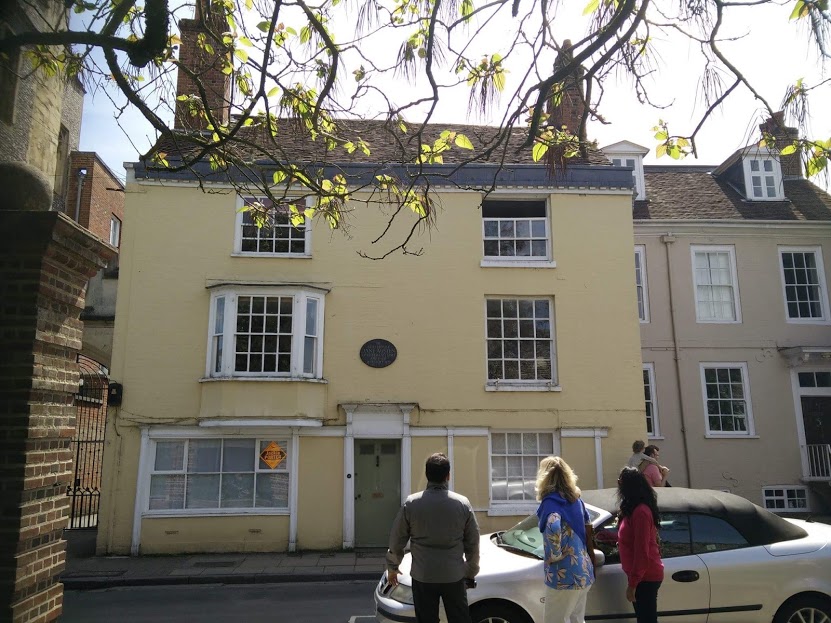
No trip to Winchester is complete without a pilgrimage to Jane Austen's final abode at 8, College Street.

The place was, as usual, flocking with tourists, but there was something entirely new: in the garden opposite her house, there was a beautiful memorial plaque covered by creepers with a lovely quote from Jane Austen:
"Know your own happiness and call it hope". The plaque has been erected in celebration of her bicentenary.

The garden offered a lovely place for a moment of rest and reflection. What a wonderful way to end this trip.

Last year I wrote about the preview of "Jane Austen 200" in Basingstoke, and this has been a very exciting year indeed as there have been several exhibitions and events in different parts of southern England to commemorate Jane Austen. Last month I visited Winchester Discovery Centre for the "Mysterious Miss Austen" exhibition. Winchester library in itself is a beautiful, period building to explore, and a lovely venue for the exhibition. We were welcomed to the exhibition with a replica Georgian dress at the bottom of the staircase.

Unfortunately, photography was not allowed at the actual exhibition as it housed several invaluable objects, for instance, Jane Austen's brown silk pelisse coat. I have taken a photo of its replica exhibited at the Allen Gallery in Alton, pictured below. There was also a lovely bead purse, said to have been made by Jane Austen, which amazed me as it was absolutely tiny.

The highlight of the exhibition, however, were the six known portraits of Jane Austen, which were for the first time housed under one roof. I have previously analysed her portraits in this article. Only two of them have been authenticated, namely the pencil sketches made by her sister, Cassandra, one showing her face (the famous one) and another showing her from behind, sitting outdoors (my icon). This explains why the portraits were absent from the 19th Century Gallery at the National Gallery, which disappointed me as I visited there earlier in May! In addition to the Victorian remake, engraved of Jane Austen's portrait, there was also a childhood portrait referred to as the "Rice Portrait", the disputed portrait owned by Paula Byrne, the mysterical silhouette, 'L'aimable Jane", from the National Portrait Gallery, and the sketch from James Stanier Clarke's scrapbook. I was especially fascinated to see Stanier Clarke's sketch, which was surprisingly tiny as well. I always thought it must be an authentic sketch of Jane Austen, showing her off in her best fashions, confident and self-assured, displaying those familiar features at a more mature age although the tiny face does not reveal much.
Downstairs in the same building there is another interesting exhibition called "Jane's Winchester: Malady and Medicine", which tells you more about life in Winchester at the time of Jane Austen.

Household items.

An ad, coins, seals, and other everyday objects from the era.

A gentleman's magazine.


The highlight for me was a rare survival of a sedan chair (below), similar to ones in which Jane Austen would travel around town as an invalid.

After visiting the exhibition, we headed to Winchester Cathedral to see their small Jane Austen exhibition.


Of course, there is the permanent display, which has been there since 2010, telling the story of Jane Austen in Winchester, but there were also some interesting fresh items, such as early editions of her books, letters and particularly the handwritten note for the text written by Henry Austen for Jane Austen's grave.

An edition of Emma, printed by John Murray, from 1816.

The church register recording Jane Austen's death.

The grave

And the manuscript for the text on the memorial stone by Henry Austen
There was also a silhouette, said to be a self-portrait of Jane Austen, but its story is yet unknown. It has been criticised for looking to Victorian to be authentic, but the origin of the portrait remains a mystery.

No trip to Winchester is complete without a pilgrimage to Jane Austen's final abode at 8, College Street.
The place was, as usual, flocking with tourists, but there was something entirely new: in the garden opposite her house, there was a beautiful memorial plaque covered by creepers with a lovely quote from Jane Austen:
"Know your own happiness and call it hope". The plaque has been erected in celebration of her bicentenary.

The garden offered a lovely place for a moment of rest and reflection. What a wonderful way to end this trip.


