Search this Blog

Showing posts with label Persuasion. Show all posts

Thursday, August 15, 2024

"There is real beauty at Lyme; and...altogether my impressions of the place are very agreeable."


Thus says Anne Elliott in Persuasion when she thinks back on her time at Lyme Regis. Seaside resorts were all the rage during Regency times, and the Austen family frequently visited resorts such as Lyme for their healing sea waters. Lyme Regis was a huge inspiration for Persuasion, and I have always wanted to visit there; I wasn't disappointed when I finally made it there last weekend. 


The sea views and views across the cliffs of the Jurassic Coast are stunning. 


Much of Lyme Regis has been preserved from the Regency times - in fact, there are several buildings that would have existed during Jane Austen's times. 


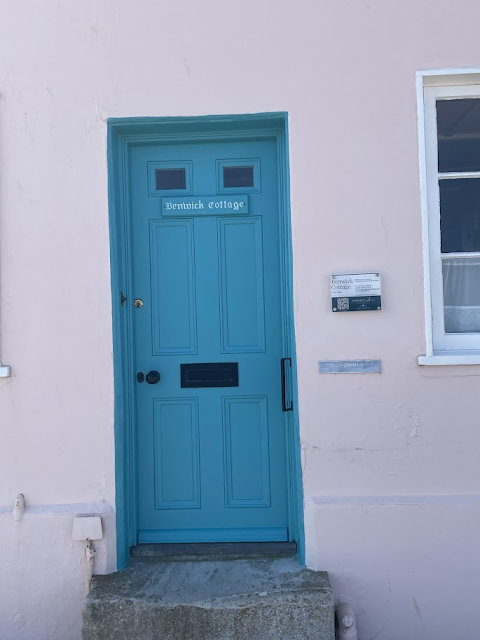
Jane Austen is believed to have stayed at this cottage at Pyne House, 10 Broad Street, when she visited Lyme in 1803 and 1804. 


The cottage is situated close to the seafront in a bustling street with several shops and restaurants. 


The seaside promenade was one of the first of its kind, created in 1771. The promenade is lined with pretty pastel-coloured cottages, such as these guesthouses. 


Wouldn't it be charming to stay with the Harvilles and Benwicks in these pastel pink cottages? 


I enjoyed browsing the Jane Austen Collection at the Lyme Regis Museum close by.  Several Jane Austen-related items that have been donated by a family member called Diana Shervington. I would love to know more about their authenticity.


This coquelicot-coloured cockade really caught my eye. Feathers and ribbons in this shade of red were fashionable after Nelson's triumph over the French at the Battle of the Nile, and this feather probably came from an egret - a heron common in the Nile Delta. This cockade is said to have belonged to Jane Austen, and I can well believe that it did; in 1798 Jane wrote in a letter about an evening cap that she was altering, "I still venture to retain the narrow silver around it, put twice round without any bow, & instead of the black military feather shall put in the Coquelicot one, as being smarter; - and besides Coquelicot is to be all the fashion this winter." (p. 26, Letters).


These glasses are said to have belonged to Cassandra Austen, Jane's older sister. They remind me of Jane's ones, which I have seen on display at the British Library. 


The gaming pieces, on the other hand, remind me of the humiliating episode at Box Hill! 


The Museum is situated in the building where the famous fossil hunter, Mary Anning, had her shop. I am fascinated by her life and had to visit her statue around the corner - I will share more about her in another post. 


No visit to Lyme Regis is complete without a walk on the Cobb. 


The walk was so pretty with the water glinting in the August sunshine. 


I also had a go at climbing down Granny's Teeth; in Persuasion, Louisa Musgrove, of course decides not to walk down these treacherous steps but tries to jump into Captain Wentworth's arms, only to fall onto the hard floor below with dreadful consequences!


I was amused by the fact that there was a warning sign at the bottom - perhaps this would have helped poor Louisa Musgrove! 

References: Le Faye, Deirdre. (2011) Jane Austen's Letters. Fourth Edition. OUP. 


Thursday, July 21, 2022

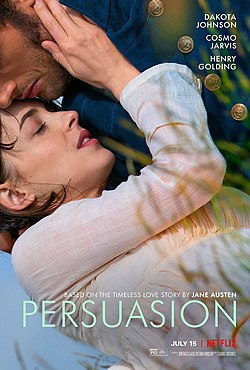
Persuasion 2022 - Jane Austen for the Instagram Generation


I thought I should jump in the bandwagon and mention my thoughts on the new Persuasion film on Netflix, starring Dakota Johnson as Anne Elliott. Having seen some screenshots, I didn't have high hopes for the film, but I decided to watch it through with an open mind and find both positives and negatives about the film. I always seem to revert back to the 1990s adaptations on Austen novels, preferring a more traditional true-to-the-book approach and struggled with the positive list to be honest, but I have made an effort! 

Here is a list of my 10 positive and 10 negative thoughts about the film: 

Pros:

1) The cinematography is beautiful - the vivid colours, lighting, angles and handheld camera shots which make some scenes seem realistic. 

2) The landscapes are lovely, especially the dramatic seaside shots in Lyme regis that remind me of Sanditon. 

3) There are several nature scenes with quaint countryside shots, which I enjoyed. 

4)  The sets are gorgeous, with a lovely range of colourful decor and stunning wallpapers and furnishings. 

5) Most of the costumes are wonderful and several look authentic - with the exception of Anne Elliott's strange wardrobe and the lack of bonnets. 

6) I enjoyed the lively scenes where Anne plays with her little nephews and nieces. I imagine Jane Austen herself would have messed around like this with children! 

7) The plot follows Jane Austen's Persuasion quite closely (although some significant scenes and characters have been omitted/changed as below). 

8) Most of the acting is decent, and I particularly enjoyed the grumpy Mary Musgrove (Mia McKenna) and the charming William Elliott (Henry Golding). (I was disappointed with Richard E Grant's Sir Walter, however, as I was looking forward to an amazing performance by him). 

9) The film is entertaining and easy for a Jane Austen novice to follow. 

10)  Persuasion 2022 introduces Jane Austen to younger generations in a fun way so that youngsters can relate to the characters - think Instagram, TikTok, Fleabag. 

The cons (which do not end here): 

1) The overall feel of Persuasion changes here - the original feel of the book is somewhat sad, autumnal, reflecting on lost opportunities. 

2) In the book, Anne is described as past her bloom, plain and melancholy and only brightens up later in the book as she begins to realise that Captain Wentworth loves her after all. Dakota Johnson's Anne, on the other hand, is gorgeous, confident, fun-loving, sarcastic and an upbeat character - even ridiculous in places, as opposed to the sensible, mature Anne of the book. 

3) The film is oblivious of formal Regency manners and etiquette, which the upper class characters would certainly have abided by. 

4) The dialogue is not taken from the original and I miss Jane Austen's beautiful language and classic quotations in this - the language here is far too modern, with phrases such as 'in-laws', 'narcissist', 'electrifying', 'playlist', 'cappuccino', 'fart around' and 'out of my league' casually thrown in. The accents don't sound right either... 

5) Anne's strange costumes, modern makeup and hair are so out of place and distract from the rest of the characters, who are much more appropriately dressed. 

6) I did not enjoy the monologues, which I only tend to appreciate in Lovejoy - but each to their own in this case. 

7) Captain Wentworth lacks charisma. He is supposed to be the head of a ship and of dozens, perhaps hundreds, of sailors, and would have to have had a strong presence to get to that position. Cosmo Jarvis' Wentworth looks dreamy and lethargic, as opposed to Ciaran Hinds' perfect rendition of the confident, charismatic captain who Anne looks up to. 

8) Period lifestyle details have been overlooked, such as in the swimming scene. Ladies of the gentry would access the water through a swimming machine to protect their modesty, as seen in Sanditon. 

9) Don't get me started on the rabbits, octopuses, 'wild wees' and Anne's drunkenness in this film!

10) Last, but not least, the plot moves too fast and a scene has been added in the middle of the film where Wentworth and Anne discuss their true feelings on the beach. Highly disappointing, as the story ought to be a slow burn, culminating in the intense letter scene at the end of the novel. 

In conclusion, if you watch Persuasion 2022 with the same mindset that you would have while watching Bridgerton, looking for easy entertainment, you might just enjoy it. The film certainly has its cringeworthy moments, but it is a quirky, modern take on a classic for the Instagram generation. 

Saturday, June 18, 2016

Following the footsteps of the Austen brothers in Portsmouth

Over the Easter holidays I travelled to Portsmouth with my family to visit the naval dockyard and in particular, the old battleships, HMS Victory and HMS Warrior. Jane Austen's brothers, Frank and Charles, were sailors, working on similar ships, as were several of Jane Austen's characters, most notably Captain Wentworth (Persuasion) and Fanny Price's brother William (Mansfield Park). 


Through her brothers, Jane Austen herself was very familiar with naval life and took a keen interest in her brothers' work, and it therefore comes as no surprise that she has used the setting so extensively in her novels. She held an admiration for the navy, and Frederick Wentworth is inarguably one of her most attractive, masculine characters. It was fascinating to get a glimpse into the world of the navy of her time and get a close viewpoint of how life was onboard and on the docks.

HMS Victory.


HMS Victory is, of course, one of the most famous battleships of Jane Austen's time, used by Nelson in the Battle of Trafalgar, the decisive sea battle against the French in which the famous admiral was shot and killed in 1805. Nelson was hugely admired and praised at the time, and Frank Austen was excited to serve under his command. Frank was upset to have missed the Trafalgar action, as he had only just been commanded elsewhere, and he never quite ceased to be disappointed. No doubt, HMS Victory must have been very similar to the boats on which Frank served.


HMS Victory is beautifully built and well maintained. The low ceiling and slanted floors of the captain's quarters, or "The Great Cabin", give an antique feel to it, in comparison to the newer Warrior. 


The living conditions were certainly better for the captain and his commanders than the sailors down below. 


The conditions on the Lower Gun Deck below were very cramped. It is dark, the ceilings are lower, and as you can see, it is difficult to get a good photo in the dim conditions. There was just a tiny hammock space allotted to each sailor, with cannons between the cots.There were 450-600 sailors dining and sleeping on the deck at the same time, and the arrangement hardly allowed any privacy. 


The food prepared in the Galley was basic but high in calories, mainly consisting of boiled beef or pork with vegetables or dried fish. Animals were kept on board for meat. The meat was salted down in casks to preserve it.


While HMS Warrior is a newer ship, built in the 1860's, seeing the interiors of the ship would give you quite a good idea of life on board. The captain and the commander's quarters were quite livable, although they were not very large. Naval life must have been very ascetic indeed back at the turn of the century, when the facilities on board were so much more basic.

Life on board was no plain sailing (excuse the pun!). Sailors often suffered from seasickness, Nelson himself included. "Decks could be like wet porous stone with dampness below in every hammock. The hacking cough of men echoed in every hour of the watch. More men died of tuberculosis than were killed by shot, and other diseases...were common" (Honan, p, 160-1.)

However, you couldn't afford to be lazy; there were brutal punishments for inefficient sailors and even the young officers in training. Flogging was commonplace. "You faced the grating with tied wrists as bosun's mates flogged your back into livery pulp. Twenty lashes for minor naval infringements were common: fifty exposed your bones. When three sailors were sentenced to 400, 500 and 600 lashes in this harbour, mates flogged at upright corpses" (Honan: p. 2).

Bloodshed was obviously part of the business, and on the Orlop Deck where wounded sailors were taken for medical assistance, there were some gruesome details on display, such as an amputated leg and some bloody instruments.


Having seen the ships, you realise that running a large ship like this must have been a mammoth task. It took hundreds of men just to lift the anchor, let alone run the machinery. It would also take a very efficient and powerful captain to run a ship and make it successful. As I was listening to the guides' stories about the ships, it made me realise just how powerful a person a naval captain would be. He would be in charge of literally hundreds of sailors and could basically do just as he pleased. He was an authoritarian head who would decide the fates of all these men and their families.


Walking down the decks, I imagined myself an Anne Elliot on board with her Captain Wentworth. Seeing the ships helped me understand the story behind Persuasion better. Being a captain was certainly a glamorous job at the time, and one could understand why Anne "gloried in being a sailor's wife". With his newly acquired prize money and fancy title, Captain Wentworth would be a thousand times more presentable in society, a powerful figure and a military hero that people would look up to - Anne Elliot not the least.

However, as I recall Mrs Croft's stories in Persuasion about life on board, describing how wonderful it was to accompany her husband, Admiral Croft, on board, it is hard to imagine anything glamorous about naval life. There was a lot of hardship in terms of food, health and general comfort, and to be one of the only ladies surrounded by hundreds of men through episodes of bloodshed, drunkenness and foul language, it baffles me how the accompanying wives coped from day to day. It reminds me of the scene in Persuasion where Captain Wentworth argues with his sister, Mrs Croft, claiming that a battleship is no place for a woman: "I hate to hear of women on board, or to see them on board; and no ship, under my command, shall ever convey a family of ladies any where, if I can help it." (Ch. 8)

Yet, this was the life that Jane Austen knew inside out and romanticised about; as described by her nephew, James-Edward Austen Leigh, "with ships and sailors she felt herself at home" (p. 18).


References: 

'Austen-Leigh, J. E. (2002) A Memoir of Jane Austen and Other Family Recollections. Oxford World Classics.

Honan, P. (1987) Jane Austen - Her Life. Phoenix Giant. 

Tuesday, March 1, 2011

Jane Austen and the Evangelicals

As I visited the Paragon in Bath, where Jane Austen spent a few weeks in 1799 with her Uncle and Aunt Leigh-Perrot, I came across this quaint little chapel across the road from the Leigh-Perrots’ lodgings.

DSCN3415

On the gate, it read “The Countess of Huntingdon’s Chapel”.

I became intrigued and was left wondering if this Countess of Huntingdon lived at the time when Jane Austen stayed in Bath, and whether Jane had anything to do with this undoubtedly formidable lady.  I decided to find out what the story was behind the church.

CountessOfHuntingdon

Countess of Huntingdon. Image from Wikipedia at http://bit.ly/heuxFG.

I discovered that the chapel was an evangelical connection set up by Selina Hastings,  Countess of Huntingdon, in the 18th Century. The Countess was born in 1707, became a born-again Christian at the age of 32 and, after she became a widow at the age of 39, she started to devote her time to religion. The Countess opened several private chapels like this for the public preaching of the gospel. After her death in 1891, there were local trusts running the chapels, and this small congregation is still active in Bath.

In Jane Austen’s times there was an evangelical revival, which would later have a great effect on the pious Victorians. The principle of the evangelicals was to express faith and to share the gospel actively and publicly. They were known for showing plenty of emotion in their worship and for singing hymns with fervour. 

Is this why Jane Austen wrote in a letter to her sister Cassandra, on January 24, 1809  [66],  "I do not like the Evangelicals", refusing to read a piece of religious fiction written by Hannah More, an evangelical reformer? Perhaps she first came across evangelicals during her first visit to Bath and, staying so close to the chapel, found them to be noisy and even vulgar?

Coelebs

Cover page for Hannah More’s “Calebs”, which Jane did not wish to read. Image from the Open Library:  http://bit.ly/fkIy2b.

For Jane Austen, religion was a more private affair. Being brought up as a moderate 18th Century Anglican clergyman’s daughter, religion was a part of her daily life, but it was demonstrated in a discreet manner. While Jane was well versed in her scriptures and attended morning prayer without fail, in her public writing she preferred to steer away from these topics, perhaps feeling that it wasn’t her place to preach. She did compose several sermons and prayers, but was otherwise undemonstrative in her approach to religion. In the Austen family, religion was demonstrated through action rather than feeling – through acts of charity and through their responsibility to the parish. The public preaching by the chapel might have put Jane off Paragon for good. She vastly preferred the location of her next lodgings at Queen’s Square, and wrote that the view from the drawing room windows was ‘far more cheerful than Paragon’.

                                                                           The Paragon as seen from the chapel.

It may be surprising, therefore, that five years later in 1814, Jane wrote in a letter to her niece, Fanny Knight, “I am by no means convinced that we ought not all to be Evangelicals, & am at least persuaded that they who are so from Reason & Feeling, must be happiest & safest.” This statement suggests that Jane may have become more religious as she grew older, perhaps growing up to see the permissive, indulgent Regency society, of whose monarch she despised. During the first two decades of the 19th Century, the evangelical movement did indeed become popular within the Anglican church, perhaps to counter the low morality of the time and to educate people of vice and virtue.

At the time when Jane Austen first stayed in Bath, she was still young and perhaps resisted restrictions on behaviour. Her later, more serious novels, such as Mansfield Park and Persuasion, reflect a less permissive approach. Fanny’s character in Mansfield Park, in particular, stands for morality and even saintliness, considering her forgiving and principled nature.  

But do Jane Austen’s novels actually show religious influences? Surely her characters make moral choices without any reference to god or religion? The debate on Jane Austen’s religiousness vs. her ambivalence towards religion continues, but I think we can safely say that Jane Austen was a practising Anglican with religion in her heart, even if she preferred not to show it to the outside world.  


Further reading:

Jane Austen’s Letters:

  • Jones, V. (2004). Selected Letters by Jane Austen. OUP.

On the history of the Chapel of the Countess of Huntingdon:

Frequently cited work on Jane Austen’s religion: