Search this Blog

Friday, November 26, 2010

Sense and Sensibility the Tamil Way

220px-Kandukondain_Kandukondain

I enjoyed seeing Aisha – the Hindi version of Jane Austen’s Emma – recently, so I decided to get hold of the Tamil version of Sense and Sensibility, too. The film from 2000 is called Kandukondain Kandukondain (translating “I Have Found it”) and is a typical South Indian film with its colourful song and dance sequences and plentiful tears and drama.

The film features some of the biggest actors and actresses from Tamil cinema, such as Ajith, Aishwarya Rai and Tabu, as well as a score by A. R. Rahman who recently received an Oscar for his score for Slumdog Millionaire.

The film begins with an action scene, showing an Indian army commando fighting Tamil rebels in the jungle. We then move onto the beautiful setting of South Indian countryside, with scenic images of swaying palm trees and lush paddy fields and characters dressed in brightly coloured sarees.

image

You soon begin to see similarities to Sense and Sensibility. The film is about two very different sisters: Sowmya (Elinor - right)  – the quiet and sensible big sister, Meenakshi (Marianne - left) – the romantic, passionate younger sister. They live with their mother, little sister and grandfather in a grand family house.

image

                                                                                                      Sowmya (Tabu)

Sowmya is the village school principal, whereas Meenakshi, full of energy, dreams of becoming a singer and is shown to spend her days running on fields, singing and reading classical poetry.

image

                                                                                        Meenakshi (Aishwarya Rai)

As their grandfather is about to die, the girls face the dilemma of marriage. Both sisters have differing views on marriage; Sowmya is determined not to marry a man of her own choice, whereas Meenakshi wants to marry for love. They both know that the wisest thing would be to marry a wealthy doctor or engineer to ensure a comfortable future for all of them.

image

                                                                                       Sowmya and Manohar (Ajith).

Manohar (Edward), an aspiring film director, has decided not to continue his father’s business against the parents’ wishes. He comes to shoot a film at the family home, and falls in love with Sowmya. However, he can’t get married until he becomes more successful in his career. In the meanwhile, Major Bala (Colonel Brandon), a wounded ex-officer (shown fighting as a commando at the beginning) who now runs an attractive florist business, falls in love with Meenakshi.

Meenakshi is not interested in this older man and falls desperately in love with a well-known businessman, Srikanth (Willoughby). The scene is a direct copy from S & S; Meenakshi is out in the rain, slips off a stone and falls, Srikanth miracuously appears from nowhere and rescues her – the next day they are seen romancing over poetry.

image                                                  Srikanth (Abbas) rescues Meenakshi in the rain.

image

                                                                                                       Love over poetry.

Following the original story, the grandfather dies, and the ladies are ousted from their family home. While everyone else despairs, the sensible Sowmya suggests that they move to Chennai – the capital city – and find work. Both the girls succeed in their careers – Sowmya at a software company and Meenakshi as a singer – and make enough money to buy a flat for the family.

In the meanwhile, Srikanth goes bankrupt and marries a rich girl for money. Meenakshi hopes to meet Srikanth in Chennai, but he never answers her calls. When she finds out that he has got married, she runs out in the rain and (instead of falling ill) falls in a drain and gets hurt. It is Major Bala that rescues her and this heroic act makes Meenakshi fall in love with this older man.

image

                                                                                 Meenakshi walking in the rain.

image

                                                            Major Bala comforting Meenakshi at the hospital.

Sowmya, on the other hand, reads in a tabloid that Manohar has been romancing an actress from his movie. When he comes to see her, she refuses to see him. Manohar convinces her that he has done nothing wrong, proposes to her, and is accepted. The film ends in an Austenesque double wedding and everyone is happy.

image

                                   Manohar proposes to Sowmya who is watching him from the balcony.

Once again, I have to reiterate how well Jane Austen’s stories adapt to Indian culture, India being a traditional, class-conscious society with strong family values. Jane Austen’s characters are so much at home in a traditional and modern Indian setting. Thanks to Jane Austen’s wonderful characterisations, it is no wonder that Kandukondain Kandukondain became one of the biggest hits in the history of Tamil cinema.

So if you don’t fall asleep while watching a film extending to three hours in length, don’t feel too sorry for the gorgeous sisters ending up with revolting looking men with various amounts of facial hair, and don’t mind the endless song-and-dance sequences, I recommend this experience to any fan of Sense and Sensibility.

Thursday, November 18, 2010

My Regency Ball Gown

When I was 17 years old, we had a prom at school. For the ball, we rehearsed traditional ballroom dances for months before the event.  It was a custom to dress in a period dress for the ball, and the style of dress was an obvious choice for me. It was to be a Regency-style dress: a long gown with a high waistline.

My mum designed and stitched the dress for me overnight, and I loved it! She still has the dress in her wardrobe, so I asked her to send a picture of the dress.

Here are some photos of the gown, with mum’s beautiful friend as a model:

 OLYMPUS DIGITAL CAMERA

The fabric is a heavy silk (unlike the light muslins of the period) with lace trimmings on the puffy sleeves and neckline.

OLYMPUS DIGITAL CAMERA          

OLYMPUS DIGITAL CAMERA

At the back, there are four buttons for dressing and undressing.

OLYMPUS DIGITAL CAMERA

The dress flows beautifully and is a delight to dance with. 

OLYMPUS DIGITAL CAMERA

I wonder if the dress still fits me… I hope to wear it to the Jane Austen festival in Bath one day. :)

Now where can I find a bonnet to match?

Sunday, November 14, 2010

‘Twas about time…


…to laminate the covers my paperback copy of The Complete Novels of Jane Austen. It was starting to become tattered due to over-usage. Now I can safely continue browsing through my favourite novels!

Saturday, November 6, 2010

Jane Austen and The Oxford Connection

During my trip to the UK, I stayed with my brother in Oxford. Through family connections, Oxford was also a place familiar to Jane Austen in many ways.

Jane Austen’s father and two of her brothers, James and Henry, studied at Oxford. Her father, and later James, became Fellows of St John’s College.


Jane’s maternal grandfather, Thomas Leigh, was a Fellow at All Souls College (below).


Thomas Leigh’s brother, Theophilus, was President of Balliol College (below) in the early 18th Century.

Balliol
                                                           From the Balliol College website: http://bit.ly/ay4oFs

In the spring of 1783, when Jane was just seven and Cassandra was ten, the sisters were sent to a boarding institution in Oxford. Being so young, Jane was probably sent there as a companion to Cassandra. At the time, Theophilus Leigh was President at Balliol and James was resident at St John’s, and could chaperone the girls.  The sisters were tutored in Oxford by a Mrs Ann Cawley, who was the widow of the former Principal of Brasenose College. Mrs Cawley was in the family – her brother, Dr Cooper, was married to Jane’s Aunt. Jane Cooper, Jane’s cousin, accompanied the sisters to Oxford.  

DSCN3542

Oxford appears to have been a gloomy place for young Jane to stay in. Mrs Cawley is said to have been “stiff and solemn” in her approach, imposing petty rules and regulations on the girls. James took the girls sightseeing through “dismal chapels, dusty libraries, and greasy halls than Jane at least could bare to remember” . Later, Jane described the experience, saying “it gave me the vapours for 2 days afterwards”. Luckily the girls were soon moved to another boarding school, which is another story altogether…

Oxford certainly influenced Jane in many ways, indirectly if not directly. With limited formal education, Jane learnt literature from her father and poetry from James, both Oxford scholars. As suggested by Issawi, her vivid style of writing may have been influenced by The Loiterer, the weekly periodical edited by James and Henry between 1789-90, while they were at Oxford.

MertonChapel

What is interesting is that many of Jane’s prominent male characters,  all clergymen, went to Oxford: Edmund Bertram, Henry Tilney, James Morland and Edward Ferrars. These are all respectable characters with strong moral values.

In Sense and Sensibility (Chapter 19), Edward describes his unfashionable choice of profession, saying “I was… entered at Oxford and have been properly idle ever since."

In Mansfield Park (Chapter 28), “Fanny proceeded in her journey safely and cheerfully, and as expeditiosly as could rationally be hoped in the dirty month of February. They entered Oxford, but she could take only a hasty glimpse of Edmund's college as they passed along”. Fanny, of course, admired Edmund for his choice of profession and was excited to see where he studied to become a clergyman.

Merton

Oxford must have left an impression on Jane, as in 1816, Jane wrote to her nephew Edward, persuading him to go to Oxford. “You must go to Oxford…a little change of scene may be good for you”, she wrote.

I can only conclude that you must go to Oxford, if you wish to know Jane Austen better!


References:
Austen-Leigh, J. E. (2002). A Memoir of Jane Austen and Other Family Recollections. Oxford World Classics.
De La Faye/Austen-Leigh, W. (2004) Jane Austen - A Family record. CUP. 
Issawi, C. (1983). Jane Austen, Oxford and Cambridge: Pride and Prejudice. Persuasions. Jane Austen Society of North America.

Monday, November 1, 2010

The First Biography of Jane Austen

I’ve finally got my hands on the most authentic piece of work on Jane Austen’s life – the memoir written by her nephew, James Edward Austen-Leigh, who knew Jane Austen when he was still young. No longer do I have to rely on an e-book!

Interestingly, this edition has been edited by Kathryn Sutherland of the disputed Austen manuscripts fame. 

JamesEdwardAusten-Leigh

                   James Edward Austen-Leigh

In 1870, over 50 years after Jane Austen’s death, Austen-Leigh asked for letters, opinions and reflections from his sisters, brothers and cousins - all those who knew Jane - and wrote this memoir with what little information he had. The memoir also features Jane’s brother, Henry Austen’s brief Memoir from 1833, Jane’s niece, Anna Lefroy’s Recollections and Caroline Austen’s Memoir, as well as letters from Jane’s nieces.

Henry

               Henry Austen

Although the Memoir is the most authentic piece of work ever written on Jane Austen’s life, we have to bear in mind that it has been written with Victorian sensibilities in mind. Some interesting details of her life were shunned to maintain the reputation of the family, such as the existence of Jane’s handicapped brother, George, and other family histories of negative connotation, such as the arrest of Jane’s aunt, Mrs Leigh-Perrot. 

AnnaLefroy2 CarolineAusten

                               Anna Lefroy                                                                         Caroline Austen

The interesting letters included in the contemporary edition truly shed light to the work behind this memoir and to what was omitted and what was included in the final edition, e.g:

  • Caroline Austen asks Austen-Leigh not to mention the name of  Harris Bigg-Wither (who proposed to Jane and was later turned down), as his family were, at the time, still living in the neighbourhood. 
  • Caroline also asks Austen-Leigh not to “rake up” the “old story” about the “Chief Justice” (her youthful romance with Tom Lefroy).
  • Caroline says to Austen-Leigh that he has been “merciful”  in omitting the most ridiculous parts of Mr Clarke’s (The Prince Regent’s librarian) letter, where he made suggestions to Jane on what she should write about in her novels (Jane subtly ignored his suggestions).

It was fascinating to read all the different accounts – while reading the memoirs and letters, you almost feel like these people are still alive and sharing all these beautiful memories of their aunt…  I highly recommend this book to anyone who wishes to become well acquainted with Jane Austen!

Saturday, October 30, 2010

Indeed, Talk Like Jane Austen Today

Today, the 30th October, The Jane Austen Society of North America are organising an event called “Talk Like Jane Austen Day”, in celebration of the 199th anniversary of the publishing of Sense and Sensibility.

To get you started with the fun, you can visit their website for a large list of language typical of Jane Austen’s time and of her novels and letters. Here are some more features of Jane’s English that I could think of:

  • Formal style in speech; using phrases, such as “I declare” and “I assure you” and “I daresay” to begin dialogue 
  • The auxiliary verb ‘is’ used instead of ‘has’ in present perfect sentences: e.g. “He is come home this morning”.
  • Double negative sentences, e.g. “she could not be insensible of”, “Fanny was not unamused”, “he was not without charm”
  • Common use of the word “indeed” to intensify speech
  • ‘Morning’ refers to the afternoon as well - “morning” represents the whole day before ‘evening’
  • Using the word “Town” to refer to “London”
  • Addressing the eldest sister “Miss”, e.g. “Miss Bennet” (for Jane) and the younger sisters with their first names, e.g. “Miss Elizabeth Bennet”, “Miss Mary Bennet”
  • Using the word “countenance” to refer to looks, the word “spirits” to refer to feelings and the word “air” to refer to general appearance
  • The phrase “a great deal” when referring to large quantities
  • Using the word “most” for “very”, e.g. “most insufferable woman”

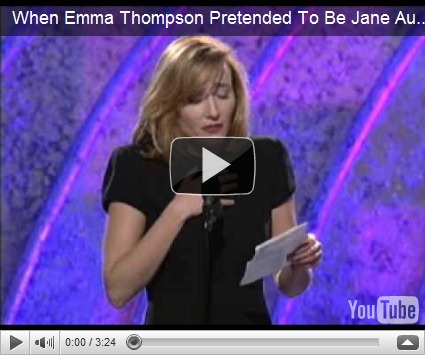
To begin the day, you could entertain yourselves with Emma Thompson’s Oscar speech from 1995, where she pretended to be Jane Austen – after this, I assure you that you will indeed find yourselves in excellent spirits!


Saturday, October 23, 2010

Win a Regency dress!

I just came across this – the gift shop at the Jane Austen Centre in Bath have set up a draw in which you can win a made-to-measure Regency style gown. The draw closes on 20th November, so all those planning to participate in next year’s dress parade, don’t miss this exciting opportunity!

WinaDress

From: http://giftshop.janeausten.co.uk/acatalog/info_687.html

Tuesday, October 19, 2010

Darcy’s Musings on Love … Drooling

My favourite part in Pride and Prejudice has to be towards the end (Chapter 60) after Mr Darcy’s second proposal to Lizzie. Lizzie asks Darcy how he first fell in love with her.

"I cannot fix on the hour, or the spot, or the look or the words, which laid the foundation. It is too long ago. I was in the middle before I knew that I had begun."

Whenever I take my bike out, I see the smug look on “Mr Darcy’s” face on the key ring and recall this beautiful scene from my favourite book…

Monday, October 11, 2010

Visiting the Georgian House Museum

On my trip to Bath, I had the opportunity to visit the Georgian House Museum. The museum is located at 1, Royal Crescent – one of Bath’s finest localities. 

RoyalCrescent_thumb1

The Royal Crescent is an elegant Georgian terrace of 30 classically designed houses in golden Bath stone. The Crescent was designed by architect John Wood the Younger between 1767 and 1774. Located close to the Circus and the Victoria Park in the Upper Town, the Crescent is an impressive sight, with lovely views across the city.  

The below picture from 1829 is from the Bath In Time website, which provides image archives of Bath throughout the ages.
Number1c_thumb1

In Jane Austen’s days, the Crescent provided luxurious lodgings to Bath’s aristocratic elite who came in to take waters and to enjoy the pleasures of the “season”.  People would go to the Crescent for an afternoon stroll, take in a bit of fresh air and meet other members of the gentry. 

Jane Austen mentions the Royal Crescent in Northanger Abbey (Chapter 9).

As soon as divine service was over, the Thorpes and Allens eagerly joined each other; and… they hastened away to the Crescent, to breathe the fresh air of better company.

Mrs Allen tells Catherine that she met with Mrs Thorpe and “We walked along the Crescent together for half an hour.” “We agreed to take a turn in the Crescent, and there we met Mrs. Hughes, and Mr. and Miss Tilney walking with her.”
 
It appears that meeting people was an integral part of an afternoon stroll by the Crescent. In 1801, Jane writes to Cassandra, “On Sunday we went to church twice, & after evening service walked a little in the Crescent fields, but found it too cold to stay long.”  In 1805 she writes, “We did not walk long in the Crescent yesterday, it was hot & not crouded enough; so we went into the field & passed close by Stephen Terry & Miss Seymer again”.   

Number1_thumb4
                                                                      From: http://bit.ly/bw2R1O

The Museum is the first house on the right. The Georgian town house has been restored to its former glory and a tour of it creates a vivid picture of Georgian lifestyle. The house has been furnished in a style that a rich family would have preferred; richly decorated rooms with heavy draping, grand paintings, authentic china, textiles and furniture. 

The drawing room, dining room, bedroom and study were interesting and had plenty of detail. The guides to the rooms were knowledgeable, with plenty of stories to share! The downstairs kitchen was a fascinating place to visit. It was well stocked with period gadgets, bake moulds, pots and pans… such a working kitchen that I could almost imagine myself rolling up my sleeves and starting to cook there and then! 

Jane Austen herself did not live in a grand house like this, but will have been familiar with many similar houses on her visits to friends and family. For anyone interested in the Georgian lifestyle, I would warmly recommend a visit to No 1! 

Unfortunately, photography was not allowed inside the museum, but you can see some photographs and further information on the museum at their website here.


References:
Jones, V. (2004). Selected Letters by Jane Austen. OUP.

Saturday, October 2, 2010

Elizabeth Gaskell and Jane Austen

Gaskell JanePortrait2
          From: http://bit.ly/adyzh1                         From: http://bit.ly/aK498V

Thanks to the recent flow of articles on Elizabeth Gaskell to mark her bicentenary, I was inspired to explore the links between Austen and Gaskell.

Although Elizabeth Gaskell lived and wrote some 40-50 years after Jane Austen, Austen’s influence can clearly be seen in her writing. In the 1860’s, Austen’s novels were being republished and were perhaps more popular than ever. It would not be surprising if Gaskell herself followed Austen’s style, or if her books were compared to those of Austen.

It is not difficult to find similarities between both writers. Both authors captured English country life proficiently. They both lead a quiet life in a country parish, surrounded by clergymen; Jane Austen’s father and two brothers were clergymen, while Gaskell was married to one. With their limited experiences, they both describe the milieu and society of small country towns and villages vividly with immense imagination.

NorthAndSouth Pride and Prej
                                                                           Girls blinded by pride and prejudice.   
           Margaret From: http://bit.ly/bMOpRu                                               Lizzie From: http://bit.ly/d0MAJs

Both authors manage to capture a wealth of characters and portray their personalities through lively dialogue. Gaskell’s Cranford with its country spinsters reminds you of Austen’s Highbury in Emma – in both novels, we meet the typical gossiping, conspiring, yet kind and charitable personalities. Like Austen, Gaskell has an array of lively female characters, who are brought to life through excellent dialogue and witty repartee. Margaret, Gaskell’s strong, dynamic female character in North and South, is not a far apart from Pride and Prejudice’s Elizabeth in attitude and intelligence – and in her prejudice of the Northern industrialist, John Thornton.

As noted by Janine Barchas in her article, both authors selected a very similar, limited array of first names for their heroes and heroines. Like Austen, Gaskell has chosen names very typical of the period: Fanny, Margaret, Frederick, Susan, Henry and John.

                                                                    Austen’s rural idyll.

While Austen chose places, imaginary and real, situated in Southern England, where she grew up, Gaskell’s stories take place in the North -compare Austen’s rural Devon, Hertfordshire and Surrey to Gaskell’s native Cheshire. This is where we come to the major differences between the writers. English country life, as Austen describes it, was still agricultural and idyllic. By Gaskell’s time, the emergence of railways and industrialism had changed the scenery, and people had had their taste of excessive realism, which entered the world of literature and the arts.

factory_manchester
                                     Manchester as Gaskell knew it. From: http://bit.ly/dzB03S

Compared to Gaskell, Jane Austen’s world view was still limited and narrow. Being a single woman, she always writes from a female point of view, and there is no scene in her books in which no woman is present. In comparison, Gaskell’s social sphere was larger, she was married with children, she had travelled more and seen more. Manchester, where she lived for a long time, was at the heart of the industrial revolution, and perhaps through her charitable work, she was aware of the disadvantages and grievances experienced by the laboured class of the time.

While Gaskell’s Wives and Daughters and Cranford remind you of Austen’s novels, North and South and Ruth are somewhat closer in style and content to fellow Victorian writers, such as Dickens, Bronte and Hardy. They describe hardships, illness and emotions with pathos, from a drastically different perspective. They are concerned with themes, such as feminism, social reform and workers’ rights well ahead of many other authors. 

Gaskell, as an author, had a social consciousness and, through her literature as well as through her charity, she wanted to make the world a better place. As opposed to Austen, who describes her immediate society from her personal experience, Gaskell deals with the society at large.

Jane Austen wrote from her limited experience and famously declared to the Prince Regent’s librarian, Rev. Clarke, to be “the most unlearned and uninformed female who ever dared to be an authoress.” Austen has been criticised for being too shallow in her approach, and writing from a tiny microcosm of society. However, the difference lies in focus; while Gaskell is clearly a social novelist, Austen goes deeper in her dealing with the human nature and its foibles. Through her sense of irony and witty dialogue, she explores the manners and morals of people and produces a wealth of timeless characters, who are still realistic and relevant in our society.

Whose literature you prefer, is clearly a matter of taste – do you prefer to read about the society at large, or about the human being as a member of a microcosm of the society?

In conclusion, I think that both the authors are brilliant and both deserve to be appreciated as classic authors of English literature. My choice would still be Austen – I can read her books again and again and still learn new things that I didn’t notice before.


This article is but a scratch on the surface of the link between Gaskell and Austen, but you can study this topic in more detail through the following fascinating articles on the life and works of Gaskell:  

Jane Austen in Vermont: Elizabeth Gaskell Bicentenary Blog Tour: Your Gaskell Library

Jane Austen’s World: Elizabeth Cleghorn Gaskell (1810-1865): A Short Description of Her Life and Career

London Calling: 84, Plymouth Grove

Not to forget this detailed and interesting article:

The Free Library:  Mrs. Gaskell's North and South: Austen's early legacy.

Sunday, September 26, 2010

What did Jane Austen look like?

All Janeites, I’m sure, wonder what their favourite author looked like.  We have a strong idea of how George Eliot, Charles Dickens and Thomas Hardy looked, based on the professional portraits and photographs that we have seen; however, to our knowledge, Jane Austen never had a formal portrait made. No doubt, this is because she never became a notable author in her lifetime and her family perhaps never expected her to rise to great fame.

NPG 3630; Jane Austen
                        From http://bit.ly/bXEtHa

The most reliable source that we are all familiar with, is the tiny pencil and watercolour sketch (above) made by Cassandra Austen, Jane’s sister, when Jane was around 35 years old. The portrait can be seen in Room 18 of the Romantics Gallery, in London’s National Portrait Gallery.

Although Cassandra was an accomplished artist, she was not a professional and the portrait has a rather unfinished look to it. While the portrait does display some of the Austen family features, Jane’s family members weren’t entirely happy with it. Years later, Jane’s niece, Anna Lefroy, claimed that the portrait was “hideously unlike”. Jane’s other nephews and nieces have the portrait only “very guarded and qualified approval…perhaps it gave some idea of the truth.”

The portrait shows us that Jane had round, rosy cheeks, a long, pointed nose, large, hazel eyes and dark brown curls around her face, corresponding to the description of her by Jane’s niece, Caroline: “Her face was rather round than long – she had a bright, but not a pink colour – a clear brown complexion and very good hazle eyes… Her hair,  a darkish brown, curled naturally – it was in short curls round her face…She always wore a cap.”

JanePortrait2
                      From: http://bit.ly/aK498V

The portrait above is, perhaps, the most common one by which Jane is known all across the world. The engraving was commissioned by Jane’s nephew, James Edward Austen-Leigh, for his book, “A Memoir of Jane Austen”, in 1870. The Victorian engraving by Lizars is based on Cassandra’s sketch, but it shows a Jane with slightly different features. In the second version, Jane even wears a wedding ring! One does wonder what Austen-Leigh thought about the portrait, having met Jane when he was a child. 

JanePortrait4
                                             From: http://bit.ly/cfxCFQ

The second most reliable source, though disappointing, is a watercolour sketch of Jane painted by Cassandra (above), showing her from behind. This was painted when Jane was 29, and Anna Lefroy referred to it as “a sketch which Aunt Cassandra made of her in one of their expeditions – sitting down out of doors on a hot day  with her bonnet strings untied.”

From this portrait we can only gather that Jane probably had a good posture and wore pastel-coloured gowns with bonnets, which were in fashion in her time. 


JanePortrait5
     From: http://bit.ly/cxwpJ3

There is a silhouette, which is often used to portray Jane Austen (above). It was found pasted in a volume of the second edition of Mansfield Park in 1944 and had the handwritten inscription ‘L’aimable Jane’. Now why would someone put a silhoutte of someone called Jane inside a Jane Austen novel, if it wasn’t of Jane Austen herself?

Think what you will, I find this inadequate evidence and would be very cautious of using the silhouette as a true portrait of Jane Austen. The silhouette does not correspond to my idea of Jane with a rather long and pointed nose, instead of the slightly upward turning, straight one portrayed here.

JanePortrait6
                                 From http://bit.ly/apfrVP

The above picture was painted by Reverend James Daniel Clarke, the Prince Regent’s librarian, after Jane visited him in Carlton House, the Prince’s residence, in 1815. The painting was found in Clarke’s friendship book and shows Jane dressed in her finest for the visit. The picture has not been authenticated, but researchers have studied the portrait and found the features matching those in Cassandra’s portrait.

JanePortrait7
                                 From: http://bit.ly/9dFxx4

The above portrait, known as the Rice portrait, was passed down generations of the Rice family, descendants of Edward Austen Leigh. Family tradition has it that this is a portrait of Jane Austen, but it is not known if it is of THE Jane Austen. I feel this is unlikely, as Jane will not have had a large, formal portrait made of her in her childhood, as there were none of Cassandra or her brothers when they were young.

                                                            *             *              *

In conclusion, we can only be certain that the two portraits painted by Cassandra Austen can be considered authentic images of Jane Austen, but they do not show Jane as the attractive woman that she was described by some to be.  We need to rely on descriptions given by people who knew Jane Austen.

When Jane was young, she was described by her neighbour Anne Lefroy’s brother, Sir Egerton Bridges, as being “fair and handsome, slight and elegant, but with cheeks a little too full”. After her death, Jane’s brother Henry described her as follows: “Her stature was that of true elegance. It could not have been increased without exceeding the middle height… Her features were separately good… her complexion was of the finest texture.”

According to Austen-Leigh, "in person she was very attractive; her figure was rather tall and slender, her step light and firm, and her whole appearance expressive of health and animation. In complexion she was a clear brunette with a rich colour; she had full round cheeks, with mouth and nose small and well-formed, bright hazel eyes, and brown hair forming natural curls close round her face."

What we do know for sure is that Jane Austen was slim, and tall by the standards of her time, with a good posture and a light step. She had a brownish complexion and good skin, and dark brown hair, which curled around her face. Her face was round, and she had full cheeks. She had hazel eyes and looking at family features, probably a long,  pointed nose and a small, straight mouth. From her late twenties onwards, she always wore a cap.


Did she look like the lady painted by forensic artist, Melissa Dring, for the Jane Austen Centre (above), who looked at Jane’s authentic portrait and tried to bring out the humour and sparkle in Jane’s eyes? Or did she indeed look old before her time, with a scowl on her face, as her portrait shows?

We can only imagine Jane with our minds’ eyes and paint our own portrait, using our imagination.

References:

Austen-Leigh, J-E. (2002). A Memoir of Jane Austen and Other Family Recollections. Oxford World Classics.
Laski, M. (1975). Jane Austen. Thames and Hudson.
Nokes, D. (1997). Jane Austen – A Life. UCP.
Tomalin, C. (1997). Jane Austen – A Life. Penguin.

Monday, September 20, 2010

The Jane Austen Companion to Life – Calendar 2011


Thank you, Internet – I have just received a beautiful wall calendar for next year. The Jane Austen Companion to Life is complete with late 19th Century illustrations from Jane Austen novels, quotes from her books, trivia and excerpts from her personal letters. I also love the pretty pastel-coloured design of the calendar. Bring on 2011!