Search this Blog

Saturday, October 30, 2010

Indeed, Talk Like Jane Austen Today

Today, the 30th October, The Jane Austen Society of North America are organising an event called “Talk Like Jane Austen Day”, in celebration of the 199th anniversary of the publishing of Sense and Sensibility.

To get you started with the fun, you can visit their website for a large list of language typical of Jane Austen’s time and of her novels and letters. Here are some more features of Jane’s English that I could think of:

  • Formal style in speech; using phrases, such as “I declare” and “I assure you” and “I daresay” to begin dialogue 
  • The auxiliary verb ‘is’ used instead of ‘has’ in present perfect sentences: e.g. “He is come home this morning”.
  • Double negative sentences, e.g. “she could not be insensible of”, “Fanny was not unamused”, “he was not without charm”
  • Common use of the word “indeed” to intensify speech
  • ‘Morning’ refers to the afternoon as well - “morning” represents the whole day before ‘evening’
  • Using the word “Town” to refer to “London”
  • Addressing the eldest sister “Miss”, e.g. “Miss Bennet” (for Jane) and the younger sisters with their first names, e.g. “Miss Elizabeth Bennet”, “Miss Mary Bennet”
  • Using the word “countenance” to refer to looks, the word “spirits” to refer to feelings and the word “air” to refer to general appearance
  • The phrase “a great deal” when referring to large quantities
  • Using the word “most” for “very”, e.g. “most insufferable woman”

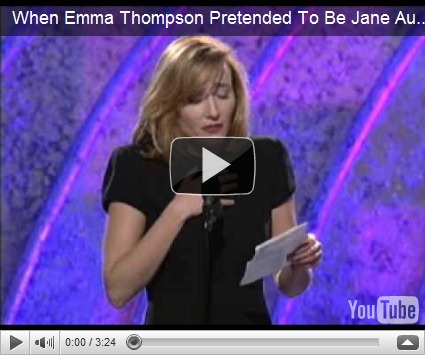
To begin the day, you could entertain yourselves with Emma Thompson’s Oscar speech from 1995, where she pretended to be Jane Austen – after this, I assure you that you will indeed find yourselves in excellent spirits!


Saturday, October 23, 2010

Win a Regency dress!

I just came across this – the gift shop at the Jane Austen Centre in Bath have set up a draw in which you can win a made-to-measure Regency style gown. The draw closes on 20th November, so all those planning to participate in next year’s dress parade, don’t miss this exciting opportunity!

WinaDress

From: http://giftshop.janeausten.co.uk/acatalog/info_687.html

Tuesday, October 19, 2010

Darcy’s Musings on Love … Drooling

My favourite part in Pride and Prejudice has to be towards the end (Chapter 60) after Mr Darcy’s second proposal to Lizzie. Lizzie asks Darcy how he first fell in love with her.

"I cannot fix on the hour, or the spot, or the look or the words, which laid the foundation. It is too long ago. I was in the middle before I knew that I had begun."

Whenever I take my bike out, I see the smug look on “Mr Darcy’s” face on the key ring and recall this beautiful scene from my favourite book…

Monday, October 11, 2010

Visiting the Georgian House Museum

On my trip to Bath, I had the opportunity to visit the Georgian House Museum. The museum is located at 1, Royal Crescent – one of Bath’s finest localities. 

RoyalCrescent_thumb1

The Royal Crescent is an elegant Georgian terrace of 30 classically designed houses in golden Bath stone. The Crescent was designed by architect John Wood the Younger between 1767 and 1774. Located close to the Circus and the Victoria Park in the Upper Town, the Crescent is an impressive sight, with lovely views across the city.  

The below picture from 1829 is from the Bath In Time website, which provides image archives of Bath throughout the ages.
Number1c_thumb1

In Jane Austen’s days, the Crescent provided luxurious lodgings to Bath’s aristocratic elite who came in to take waters and to enjoy the pleasures of the “season”.  People would go to the Crescent for an afternoon stroll, take in a bit of fresh air and meet other members of the gentry. 

Jane Austen mentions the Royal Crescent in Northanger Abbey (Chapter 9).

As soon as divine service was over, the Thorpes and Allens eagerly joined each other; and… they hastened away to the Crescent, to breathe the fresh air of better company.

Mrs Allen tells Catherine that she met with Mrs Thorpe and “We walked along the Crescent together for half an hour.” “We agreed to take a turn in the Crescent, and there we met Mrs. Hughes, and Mr. and Miss Tilney walking with her.”
 
It appears that meeting people was an integral part of an afternoon stroll by the Crescent. In 1801, Jane writes to Cassandra, “On Sunday we went to church twice, & after evening service walked a little in the Crescent fields, but found it too cold to stay long.”  In 1805 she writes, “We did not walk long in the Crescent yesterday, it was hot & not crouded enough; so we went into the field & passed close by Stephen Terry & Miss Seymer again”.   

Number1_thumb4
                                                                      From: http://bit.ly/bw2R1O

The Museum is the first house on the right. The Georgian town house has been restored to its former glory and a tour of it creates a vivid picture of Georgian lifestyle. The house has been furnished in a style that a rich family would have preferred; richly decorated rooms with heavy draping, grand paintings, authentic china, textiles and furniture. 

The drawing room, dining room, bedroom and study were interesting and had plenty of detail. The guides to the rooms were knowledgeable, with plenty of stories to share! The downstairs kitchen was a fascinating place to visit. It was well stocked with period gadgets, bake moulds, pots and pans… such a working kitchen that I could almost imagine myself rolling up my sleeves and starting to cook there and then! 

Jane Austen herself did not live in a grand house like this, but will have been familiar with many similar houses on her visits to friends and family. For anyone interested in the Georgian lifestyle, I would warmly recommend a visit to No 1! 

Unfortunately, photography was not allowed inside the museum, but you can see some photographs and further information on the museum at their website here.


References:
Jones, V. (2004). Selected Letters by Jane Austen. OUP.

Saturday, October 2, 2010

Elizabeth Gaskell and Jane Austen

Gaskell JanePortrait2
          From: http://bit.ly/adyzh1                         From: http://bit.ly/aK498V

Thanks to the recent flow of articles on Elizabeth Gaskell to mark her bicentenary, I was inspired to explore the links between Austen and Gaskell.

Although Elizabeth Gaskell lived and wrote some 40-50 years after Jane Austen, Austen’s influence can clearly be seen in her writing. In the 1860’s, Austen’s novels were being republished and were perhaps more popular than ever. It would not be surprising if Gaskell herself followed Austen’s style, or if her books were compared to those of Austen.

It is not difficult to find similarities between both writers. Both authors captured English country life proficiently. They both lead a quiet life in a country parish, surrounded by clergymen; Jane Austen’s father and two brothers were clergymen, while Gaskell was married to one. With their limited experiences, they both describe the milieu and society of small country towns and villages vividly with immense imagination.

NorthAndSouth Pride and Prej
                                                                           Girls blinded by pride and prejudice.   
           Margaret From: http://bit.ly/bMOpRu                                               Lizzie From: http://bit.ly/d0MAJs

Both authors manage to capture a wealth of characters and portray their personalities through lively dialogue. Gaskell’s Cranford with its country spinsters reminds you of Austen’s Highbury in Emma – in both novels, we meet the typical gossiping, conspiring, yet kind and charitable personalities. Like Austen, Gaskell has an array of lively female characters, who are brought to life through excellent dialogue and witty repartee. Margaret, Gaskell’s strong, dynamic female character in North and South, is not a far apart from Pride and Prejudice’s Elizabeth in attitude and intelligence – and in her prejudice of the Northern industrialist, John Thornton.

As noted by Janine Barchas in her article, both authors selected a very similar, limited array of first names for their heroes and heroines. Like Austen, Gaskell has chosen names very typical of the period: Fanny, Margaret, Frederick, Susan, Henry and John.

                                                                    Austen’s rural idyll.

While Austen chose places, imaginary and real, situated in Southern England, where she grew up, Gaskell’s stories take place in the North -compare Austen’s rural Devon, Hertfordshire and Surrey to Gaskell’s native Cheshire. This is where we come to the major differences between the writers. English country life, as Austen describes it, was still agricultural and idyllic. By Gaskell’s time, the emergence of railways and industrialism had changed the scenery, and people had had their taste of excessive realism, which entered the world of literature and the arts.

factory_manchester
                                     Manchester as Gaskell knew it. From: http://bit.ly/dzB03S

Compared to Gaskell, Jane Austen’s world view was still limited and narrow. Being a single woman, she always writes from a female point of view, and there is no scene in her books in which no woman is present. In comparison, Gaskell’s social sphere was larger, she was married with children, she had travelled more and seen more. Manchester, where she lived for a long time, was at the heart of the industrial revolution, and perhaps through her charitable work, she was aware of the disadvantages and grievances experienced by the laboured class of the time.

While Gaskell’s Wives and Daughters and Cranford remind you of Austen’s novels, North and South and Ruth are somewhat closer in style and content to fellow Victorian writers, such as Dickens, Bronte and Hardy. They describe hardships, illness and emotions with pathos, from a drastically different perspective. They are concerned with themes, such as feminism, social reform and workers’ rights well ahead of many other authors. 

Gaskell, as an author, had a social consciousness and, through her literature as well as through her charity, she wanted to make the world a better place. As opposed to Austen, who describes her immediate society from her personal experience, Gaskell deals with the society at large.

Jane Austen wrote from her limited experience and famously declared to the Prince Regent’s librarian, Rev. Clarke, to be “the most unlearned and uninformed female who ever dared to be an authoress.” Austen has been criticised for being too shallow in her approach, and writing from a tiny microcosm of society. However, the difference lies in focus; while Gaskell is clearly a social novelist, Austen goes deeper in her dealing with the human nature and its foibles. Through her sense of irony and witty dialogue, she explores the manners and morals of people and produces a wealth of timeless characters, who are still realistic and relevant in our society.

Whose literature you prefer, is clearly a matter of taste – do you prefer to read about the society at large, or about the human being as a member of a microcosm of the society?

In conclusion, I think that both the authors are brilliant and both deserve to be appreciated as classic authors of English literature. My choice would still be Austen – I can read her books again and again and still learn new things that I didn’t notice before.


This article is but a scratch on the surface of the link between Gaskell and Austen, but you can study this topic in more detail through the following fascinating articles on the life and works of Gaskell:  

Jane Austen in Vermont: Elizabeth Gaskell Bicentenary Blog Tour: Your Gaskell Library

Jane Austen’s World: Elizabeth Cleghorn Gaskell (1810-1865): A Short Description of Her Life and Career

London Calling: 84, Plymouth Grove

Not to forget this detailed and interesting article:

The Free Library:  Mrs. Gaskell's North and South: Austen's early legacy.

Sunday, September 26, 2010

What did Jane Austen look like?

All Janeites, I’m sure, wonder what their favourite author looked like.  We have a strong idea of how George Eliot, Charles Dickens and Thomas Hardy looked, based on the professional portraits and photographs that we have seen; however, to our knowledge, Jane Austen never had a formal portrait made. No doubt, this is because she never became a notable author in her lifetime and her family perhaps never expected her to rise to great fame.

NPG 3630; Jane Austen
                        From http://bit.ly/bXEtHa

The most reliable source that we are all familiar with, is the tiny pencil and watercolour sketch (above) made by Cassandra Austen, Jane’s sister, when Jane was around 35 years old. The portrait can be seen in Room 18 of the Romantics Gallery, in London’s National Portrait Gallery.

Although Cassandra was an accomplished artist, she was not a professional and the portrait has a rather unfinished look to it. While the portrait does display some of the Austen family features, Jane’s family members weren’t entirely happy with it. Years later, Jane’s niece, Anna Lefroy, claimed that the portrait was “hideously unlike”. Jane’s other nephews and nieces have the portrait only “very guarded and qualified approval…perhaps it gave some idea of the truth.”

The portrait shows us that Jane had round, rosy cheeks, a long, pointed nose, large, hazel eyes and dark brown curls around her face, corresponding to the description of her by Jane’s niece, Caroline: “Her face was rather round than long – she had a bright, but not a pink colour – a clear brown complexion and very good hazle eyes… Her hair,  a darkish brown, curled naturally – it was in short curls round her face…She always wore a cap.”

JanePortrait2
                      From: http://bit.ly/aK498V

The portrait above is, perhaps, the most common one by which Jane is known all across the world. The engraving was commissioned by Jane’s nephew, James Edward Austen-Leigh, for his book, “A Memoir of Jane Austen”, in 1870. The Victorian engraving by Lizars is based on Cassandra’s sketch, but it shows a Jane with slightly different features. In the second version, Jane even wears a wedding ring! One does wonder what Austen-Leigh thought about the portrait, having met Jane when he was a child. 

JanePortrait4
                                             From: http://bit.ly/cfxCFQ

The second most reliable source, though disappointing, is a watercolour sketch of Jane painted by Cassandra (above), showing her from behind. This was painted when Jane was 29, and Anna Lefroy referred to it as “a sketch which Aunt Cassandra made of her in one of their expeditions – sitting down out of doors on a hot day  with her bonnet strings untied.”

From this portrait we can only gather that Jane probably had a good posture and wore pastel-coloured gowns with bonnets, which were in fashion in her time. 


JanePortrait5
     From: http://bit.ly/cxwpJ3

There is a silhouette, which is often used to portray Jane Austen (above). It was found pasted in a volume of the second edition of Mansfield Park in 1944 and had the handwritten inscription ‘L’aimable Jane’. Now why would someone put a silhoutte of someone called Jane inside a Jane Austen novel, if it wasn’t of Jane Austen herself?

Think what you will, I find this inadequate evidence and would be very cautious of using the silhouette as a true portrait of Jane Austen. The silhouette does not correspond to my idea of Jane with a rather long and pointed nose, instead of the slightly upward turning, straight one portrayed here.

JanePortrait6
                                 From http://bit.ly/apfrVP

The above picture was painted by Reverend James Daniel Clarke, the Prince Regent’s librarian, after Jane visited him in Carlton House, the Prince’s residence, in 1815. The painting was found in Clarke’s friendship book and shows Jane dressed in her finest for the visit. The picture has not been authenticated, but researchers have studied the portrait and found the features matching those in Cassandra’s portrait.

JanePortrait7
                                 From: http://bit.ly/9dFxx4

The above portrait, known as the Rice portrait, was passed down generations of the Rice family, descendants of Edward Austen Leigh. Family tradition has it that this is a portrait of Jane Austen, but it is not known if it is of THE Jane Austen. I feel this is unlikely, as Jane will not have had a large, formal portrait made of her in her childhood, as there were none of Cassandra or her brothers when they were young.

                                                            *             *              *

In conclusion, we can only be certain that the two portraits painted by Cassandra Austen can be considered authentic images of Jane Austen, but they do not show Jane as the attractive woman that she was described by some to be.  We need to rely on descriptions given by people who knew Jane Austen.

When Jane was young, she was described by her neighbour Anne Lefroy’s brother, Sir Egerton Bridges, as being “fair and handsome, slight and elegant, but with cheeks a little too full”. After her death, Jane’s brother Henry described her as follows: “Her stature was that of true elegance. It could not have been increased without exceeding the middle height… Her features were separately good… her complexion was of the finest texture.”

According to Austen-Leigh, "in person she was very attractive; her figure was rather tall and slender, her step light and firm, and her whole appearance expressive of health and animation. In complexion she was a clear brunette with a rich colour; she had full round cheeks, with mouth and nose small and well-formed, bright hazel eyes, and brown hair forming natural curls close round her face."

What we do know for sure is that Jane Austen was slim, and tall by the standards of her time, with a good posture and a light step. She had a brownish complexion and good skin, and dark brown hair, which curled around her face. Her face was round, and she had full cheeks. She had hazel eyes and looking at family features, probably a long,  pointed nose and a small, straight mouth. From her late twenties onwards, she always wore a cap.


Did she look like the lady painted by forensic artist, Melissa Dring, for the Jane Austen Centre (above), who looked at Jane’s authentic portrait and tried to bring out the humour and sparkle in Jane’s eyes? Or did she indeed look old before her time, with a scowl on her face, as her portrait shows?

We can only imagine Jane with our minds’ eyes and paint our own portrait, using our imagination.

References:

Austen-Leigh, J-E. (2002). A Memoir of Jane Austen and Other Family Recollections. Oxford World Classics.
Laski, M. (1975). Jane Austen. Thames and Hudson.
Nokes, D. (1997). Jane Austen – A Life. UCP.
Tomalin, C. (1997). Jane Austen – A Life. Penguin.
Monday, September 20, 2010

The Jane Austen Companion to Life – Calendar 2011


Thank you, Internet – I have just received a beautiful wall calendar for next year. The Jane Austen Companion to Life is complete with late 19th Century illustrations from Jane Austen novels, quotes from her books, trivia and excerpts from her personal letters. I also love the pretty pastel-coloured design of the calendar. Bring on 2011!


Sunday, September 12, 2010

Austen Keepsakes in a Scrapbook

Having returned from my UK trip, I suddenly had plenty of Austen-related paraphernalia with me: postcards, brochures, entrance tickets etc. I decided to keep these things and store them in a tiny scrapbook, which I could browse whenever I felt like reminiscing all the fascinating places I visited. 

I purchased this postcard at the National Portrait Gallery, where I had the chance to see the one and only certain life portrait of Jane Austen, sketched by Cassandra Austen. The portrait was stored in a glass case in Room 18 of the Romantics Gallery, and I was surprised to see how tiny the portrait really was – the postcard is, in fact, larger than the portrait itself! It is a pencil sketch with light colouring on and around the face, appearing somewhat incomplete. 

On the next page, I stuck two brochure cut-outs of other Austen portraits.  The one on the left is a silhouette that was discovered in an early edition of Pride and Prejudice. Behind the silhouette were the words ‘L’aimable Jane’, convincing some that this was indeed a silhouette of Jane Austen. The picture on the right is an engraving of the original portrait by Cassandra Austen – pretty but with a slightly different look on Jane’s face.

I purchased this lovely postcard at Jane Austen’s House in Chawton. It displays the various places in Hampshire that Jane lived in and visited.

On the next page, I stuck a helpful brochure for a Jane Austen trail in Alton and Chawton, provided by Alton Chamber of Commerce and Industry. I used this as a guide on my trip to Chawton and Alton.

The next page has pictures of Hampshire: Steventon Church, which I’m sorry to have missed on my trip, and Chawton. There is also a small introduction to the Jane Austen Exhibition, which I saw at Winchester Cathedral. I like the sentence at the top of the brochure: ‘It is a truth universally acknowledged that a visitor to Hampshire must be in search of an appreciation of Jane Austen’!

These pictures are of the various rooms in Jane Austen’s House at Chawton (from the museum brochure) and my entrance ticket to the museum.

This rather crumpled-up cut-out from a brochure, which I received at the Jane Austen Centre in Bath, shows the Austen family tree.

I bought this crowded, yet informative postcard at the Jane Austen Centre, displaying the different places that Jane Austen stayed in and where the characters of her novels venture out in Bath.

The next page is dedicated to Bath, with my entrance tickets to the Georgian House Museum and the Fashion Museum/Assembly Rooms.

Jane Austen’s iconic writing desk deserved to have a page of its own.

This postcard from the Jane Austen Centre is of a letter sent by Jane Austen to her sister Cassandra – her friend and confidante. Jane sent this letter from Queen Square and in it she describes how pleased she is with their lodgings, as opposed to their earlier rooms at the Paragon.  It is amazing, as always, to read her handwriting, which is as stable as print and a piece of art by itself.

Finally, the below cut-out from the Jane Austen Centre brochure displays the chronology of Jane Austen’s life, from her parents’ marriage to the posthumous publication of her books.

Have you made similar scrapbooks of your trips?

Thursday, August 26, 2010

Following Jane’s Last Journey

In 1816, when Jane Austen was 41, her health was becoming weaker and friends noticed a change in her. She suffered from fever and weakness, and was becoming more serious. Although she was very courageous, she must have been aware of the gravity of her situation, as in March, she made her will.

Jane was being treated by the Alton Apothecary, William Curtis, who called in a surgeon from Winchester, Mr Gyles King Lyford. As Jane was improving under his care, it was decided that Jane would travel to Winchester to be under his treatment.

Winchester was a convenient spot for me to travel to Chawton, and before heading off to Chawton by bus, I spent some time exploring the place where Jane breathed her last.

Winchester is a compact town to walk around, and has retained plenty of its traditional architecture. Walking down the quieter streets of Winchester, one could equally well be in the 19th Century if it wasn’t for the cars. 

Most of the roads were narrow and winding, and the houses were a blend of the Georgian and the Victorian.

DSCN3599

The house where Jane lived the last days of her life was in College Street, right behind the walls of Winchester Cathedral. It’s a quiet street, very much unchanged since the 19th Century.

DSCN3566

The house in 8, College Street, remains on the facade as it was in Jane’s lifetime. She wrote, ‘Our lodgings are very comfortable. We have a neat little drawing room with a bow window overlooking Dr Gabell’s Garden.’

DSCN3562

The view from Jane’s lodgings:

It was here that Jane lived, probably watching the cathedral that she admired very much. She would go out in a sedan chair, optimistic that she would be shifted to a wheelchair in the summer. However, as there was no knowledge of her disease at the time – now often referred to as Addison’s disease – there wasn’t much that Dr Lyford could have done.

On the morning of July 18th, 1817, Jane passed away in Cassandra’s arms. From the bow-shaped windows, Cassandra watched as her sister’s funeral hearse went past towards the Cathedral, where Jane was to be buried.

DSCN3565

From College Street, I turned right to Kingsgate, which leads you to Winchester Cathedral.

DSCN3569

In front of Winchester Cathedral.

Jane is buried in the north aisle of the church. The verses written on her grave, perhaps by her brother Henry, are beautiful, describing her as a person – however, there is no mention of her being an authoress.

It was comforting to know that Jane was buried in a place that she admired so very much. It did cross my mind, though, that perhaps she would have preferred to have been buried in Steventon – her birthplace, which she loved dearly.

At the time of my visit, there was an exhibition dedicated to Jane Austen’s life in the Cathedral. There was also a small set of Jane Austen memorabilia in the City Museum. Therefore I would say that Winchester was well worth a visit.


References: Edwards, A-M. (1991). In the Steps of Jane Austen – Walking Tours of Austen’s England. Wisconsin: Jones Books.